Revision History
Note: The guide is effectively complete at this point; We’re still enhancing, maintaining and updating it but all the core information is now present.
| Game Version | Document Version | Release Date | Changes |
|---|---|---|---|
| 4.2.2.0 (10/11/25) | 2.4.0 | WIP | 2.4.0 Will update based on latest fixes, and focus on more data on population, system stats, and more details TO ADD: Dodec details; Impact of nerf (if it remains) TO ADD: Even more screenshots, color, prettyness! FIXED: Black market info, extra stats info, some additional strategy info (thank you Ian and others!) FIXED: Q&A statements; Station interiors w/ proper lighting based on controlling faction (thank you Raghav and others!) |
| 4.2.1.2 (16/10/25) | 2.3.0 | October 31, 2025 | ADDED: Agri bug & clarified top-two-economies mechanism; Also some more information on System Security and population data REPLACED: Whole pop section, now that we have precise formulae FIXED: Service economy, stacking for planetary ports, other minor items (thanks Dubior!) |
| 2.2.0 | October 30, 2025 | TO FIX: Modifiers on planetary intrinsics DO apply (e.g., Volcanism) ADDED: New appendix with by-facility scores; Also added sec slider comparisons; FAQ section;Appendix with detailed economy overlaps; More info on station population; More screenshots, color, prettyness! Dual-economy compatibility; Anarchy BGS case FIXED: Clarified some requirements for services at ports; Clarified System Score / Credits CHANGED: Moved acknowledgements up, tweaked them; Enhance examples of ‘ideal economy type’ | |
| 2.1.0 | October 23, 2025 | ADDED: Section on Impact of Population + Appendix on ‘advanced strategies’ + Section on score and credits per week FIXED: Updated Spansh (remove build, as now has colonization bridge plotter) + Clarify primary port can be cancelled anytime + Minor aspect on Volcanism + Fixed Shipyards on space outposts (which cannot have them, period) | |
| 2.0.1 | October 19, 2025 | Minor fixes related to color commentary left over from v 1.x + formatting Updated document roadmap | |
| 2.0.0 | October 18, 2025 | Updated whole document per economy, deconstruction and sniping major game changes Removed Beta designation; Reworked appendixes Added Panther build. Removed fixed issue trackers. Added deconstruction section. Fixed market requirements table per 3.3 patch updates in forum1. Updated appendix screens. Removed section on sniping defense and replaced with info on exclusivity period. Plus several other clarifications (primarily on modifier stacking and bugs), footnoting and minor fixes (thanks again CMDR Dubior and Jayzet). Added Raven Colonial planner and link Added interior types / images | |
| 4.1.2.102 (04/06/25) | 1.4.0 Beta | October 1, 2025 | Fixed a bunch of stuff (thanks CMDR Dubior), mostly on market type acquisition |
| 1.3.2 Beta | June 15, 2025 | Fixed Vista Genomics activation requirement; Added audiobook link; Noted U3.3 post-publishing patch notes updates; Minor other formatting fixes. | |
| 1.3.1 Beta | June 12, 2025 | Minor fixes and updates (Pioneer Supplies availability, instructions for printing, etc.); Also added two additional community groups for contracting | |
| 1.3 Beta | June 4, 2025 | Incorporated updates from TB Update 3.3. Added comment on variable economy value of strong links. | |
| 4.1.2.101 (16/05/25) | 1.2 Beta | June 3, 2025 | Added strong-link modifier effect for Agri and HiTech of water worlds2. Added in-game codex and update patch note appendixes, for ease of access; Added (bare-bones) “happiness” to system statistics; Added “supporting facility” definition and explained mechanic of how ports can become supporting facilities in certain circumstances - and clarified case studies accordingly; Added Bugs, Known Issues, And Possible Workarounds |
| 1.1 Beta | June 2, 2025 | Added CMM Composites case study, various stylistic updates, minor numerical error fixes, minor content updates, added additional community resources, separated revision history and added instructions for printer-friendly version; Fixed faction-selection logic [thanks to SCC for correcting that!]; Fixed specialized port economic values and clarified bonus strength values [thank you Ned Flandalorian!] | |
| 1.0 Beta | June 1, 2025 | Initial Version |
Acknowledgements
It takes a village (or a dozen) to make sense of Elite Dangerous’s game mechanics
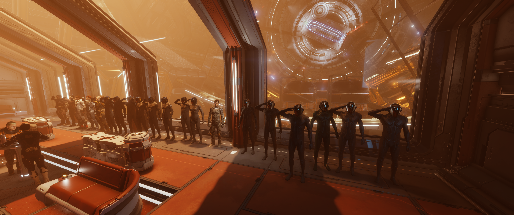
This is the “game manual” for colonization in Elite Dangerous. Or, at least, it is the community’s best attempt at creating one.
The creation of this manual could never have been possible without the extraordinary effort of dozens of CMDRs who gathered data, tested hypotheses, created tools, wrote-up analyses and contributed in countless other ways to this document’s evolution from half-baked scratchpad, to authoritative reference manual.
It is impossible to acknowledge every single contributor, but there are a few who went above and beyond and deserve some degree of special recognition.
In no particular order:
- CMDR Grinning2001 is the creator and maintainer of Raven Colonial, the go-to platform for both aspiring and experienced system architects.
- CMDR DaftMav designed a hugely-helpful planning spreadsheet, which was the reference tool for system architecting in the earlier days of colonization and remains a handy tool today. Much of his documented game-logic and game-data fed accelerated development of Raven Colonial, and contributed to this document as well
- CMDRs Raghav102 and Nyatto researched and wrote specific sections of this guide themselves
- CMDR Betel01 who painstakingly and diligently recorded over one hundred days of population and production data; without his efforts, we wouldn’t have the formulae we do
- CMDRs Jayzet, Dubior, Ned Flandalorian, and Ian Doncaster provided quality criticism and constructive additions to many sections of this document, either directly, or indirectly (through their own posts on Reddit / Forums / Discord)
- CMDRs Void Coefficient and AlexMG1 for quality control reviews and content input
In addition, several communities deserve acknowledgment:
- The AXI #colonize_goids_away community, where much discussion on this document takes place on a regular basis, and the Xeno Strike Force Discord in general
- The Canonn #colonization_department Discord channel participants for their invaluable input
- The Col 285 Water Bubble Team for letting us use their fancy image upfront
- All Xeno Strike Force and Anti Xeno initiative community members for the input, thought partnership, help and support
- SCCN and FREIGHT (among others) for
milking us dry of our hard AX-earned creditsproviding an invaluable contract service for building up systems quickly - All other community members who have provided input, sent data, traded ideas, or otherwise contributed directly and indirectly to this guide
Last, but far from least, there’s FDEV to thank. They could have abandoned Trailblazers and left it as the original broken wreck that it came out originally as (a fate already befallen to CQC, Multicrew, PMFs, and a good chunk of the BGS). But they didn’t. They stuck with it and, little at a time, they fixed it (or, at least, they fixed all the critical things that really needed fixing.) We are deeply thankful for their game, for their work in bringing Colonization to Elite Dangerous, and for their grit and perseverance in making it work properly.
If you find this guide useful - buy some ARX and support the game!
Table of Contents
Why Colonize? Purpose, Goals, and Downsides 9
What Do You Need To Get Started? 16
How To Claim A System? Bridging, Claiming, And The Exclusivity Period 17
Finding a Colonization Contact 17
Making a Claim & Selecting the Primary Port 18
How BGS Factions Operate In Colonization Affairs 20
Deploying the System Colonization Beacon 21
Bridging Towards Far-Away Claims 23
How To Architect A System? Construction Points, And A Tool You Will Love 25
Introduction To Building Up A System 25
Before You Start: CP-Cost Increases For Tier 2 And Tier 3 Ports 27
How To Effectively Plan For System Construction 29
The Value Of Space Versus Ground Slots 33
Naming And Customizing Your Facilities 34
Canceling And Deconstructing Facilities 42
How Do Colony-Type Ports Gain Economies? Base Inheritable Economy + Modifiers 47
What Are Strong & Weak Links? How Are They Modified By Link Modifiers? 52
Special Case: Port-to-Port Strong Links 58
Special Case: When Ports Convert To Being Supporting Facilities 59
What Do Security, Wealth, SoL, Tech Level, Dev Level, And Population Do? 60
What To Consider When Selecting A Primary Port? 64
What To Consider When Selecting A System To Architect? 66
Which Economies Are Compatible With Each Other? 68
What Does Population Affect, And How Do I Grow It? 75
System Score And Credits Per Week 80
How To Haul Effectively And Make Best Use Of Carriers? 81
“Contractors” And Community Support 83
Case Study #1: Building An “Ideal” Refinery System 84
Case Study #2: Building An “Ideal” Agriculture System 87
Bugs, Known Issues, And Possible Workarounds 92
Appendix A: Advanced Strategies 95
Farming Tier 3 CPs, then deconstructing and replacing 95
“Sheltering” a lower-tier port beneath a higher-tier one 95
“Dumping” Tech Level system stat 96
Build Tier3s first (and before T2 ports) 96
“Nesting” ports to create industry or refinery strong links without ground slots 96
“Nesting” ports to spawn specific types of missions 97
Appendix B: Links And Resources 98
Appendix C: Detailed By-Facility System Scores 99
Appendix D: Detailed Overlap Of Economy Pairs 100
Appendix E: Colonization In-Game Codex 115
Terms And Definitions
Throughout this document, when we use the following terms, we mean what is described in the table below.
Note: Colonization is a complex topic, and this initial terminology table may appear overwhelming at first. If this is your first time reading through, feel free to skip it and come back to it later if you find something in this document confusing [and let us promise you - you will :) ].
| Term | Meaning |
|---|---|
| “Facility” | Any space OR ground construction architectured and built by one or more CMDRs. Anything you build is a facility. |
| “Tier 1/2/3” (or just “T1/2/3”) | The tier of a facility or of construction points generated / required by facilities. There are three facility tiers: T1/2/3. To build at Tier 2 and 3 you will require construction points. There are two construction point tiers: T2/3 (there are no “Tier 1” construction points.) Tier 1 facilities require no construction points and generate Tier 2 construction points. Tier 2 facilities require Tier 2 construction points and generate Tier 3 construction points. Tier 3 facilities require Tier 3 construction points and generate no construction points.3 |
| “Port” | A specific type of facility, to include both Spaceports and Planetary Ports, as described below. |
| “Space Port” (or “Spaceport”) | A specific type of facility, to include: Tier 1 - space outposts Tier 2 - coriolis ports, asteroid bases Tier 3 - orbis and ocellus starports |
| “Planetary Port” | Either a Tier 1 [Planetary] Outpost or Tier 3 Planetary Port. There are no Tier 2 Planetary Ports. |
| “Settlement” | A PLANETARY facility (not including hubs nor planetary ports). Settlements coming in Tier 1 can be “small” or “medium” sizes. Tier 2 settlements are always “large”. |
| “Hub” | A specific category of PLANETARY facility. Hubs are always of Tier 2, and have no size rating. |
| “Installation” | Anything built in space which isn’t a spaceport. |
| “Primary Port” | The very first facility built in a given system. This must be a Spaceport, but a CMDR can select which type. Its location is also pre-set and cannot be changed. Primary Ports are built by Colonization Megaships, are 17-25% more material-expensive than equivalent non-primary spaceports, and must be built within 4 weeks of claiming. |
| “Supporting Facility” | In general, any facility which isn’t a Port, with one important exception: lower-tier (and same same-tier-later-built) Ports in the same local body as higher-tier (or same-tier-earlier-built) Ports, will also act as supporting facilities (and thus emit strong and weak links.) Only supporting facilities emit strong and weak links. |
| “Prerequisite” | Certain facilities require specific other facilities to be built before they can, in turn, be constructed. As an example, completing a Military Settlement is a prerequisite to building a Military Installation. Prerequisites apply on a system-by-system basis. |
| “Local Body” | The body to which your construction is immediately connected. This does NOT include the moons of said body. “Local Body” is a key concept in determining how strong links are formed, where modifiers apply, and which economy types colony-type ports inherit (see relevant chapters for details). |
| “Colony-type Port” | A subset of all ports - those which have “Colony” as their economy type, and thus are notable for “acquiring” a specific economy type based on local body characteristics (other ports are NOT subject to this effect.) Colony Type ports include Civilian and Commercial [Space] Outposts, Coriolis, Orbis, Ocellus, Civilian [Planetary] Outpost, and the Planetary [Tier 3] Port. Asteroid Bases and all other [Space and Planetary] outposts are instead specialized ports. |
| “Specialized Port” | All ports which are not of Colony type (see above) and thus have a specific inherent economy type, and which do NOT inherit an economy based on local body characteristics. They can, however, still have their market types affected by strong and weak links. |
| “Bridge” / “Bridging” / “Daisy-chaining” | A chain of outposts built for the sole intent of reaching a particular far-away system, one small 15 LY hop at a time. Bridge outposts are typically abandoned after being built, having served their purpose of making the subsequent claim. |
| “Sniping [a system/claim]” | The act of rushing to a newly-created primary port for the intent of making a competitive claim, without having put in any meaningful effort towards building the “bridge” towards said claim. This was a major issue until game version 4.2.1.2, which introduced an “exclusive claim period” for system architects and their squadron, essentially mitigating this problem. |
| [Local Body] Base Inheritable Economy | A colony-type port will inherit certain characteristics based on the local body it is built on or around. For example, absent other modifiers, a Coriolis Station orbiting a Rocky planet will inherit a Refinery economy. |
| [Local Body] Inheritable Economy Modifier | The modifiers to inheritable economies which certain local body characteristics grant. For example, if a given body has any organics, +1.0 Agriculture and +1.0 Terraforming will be added to its Base Inheritable Economy (if not already present), noting that these modifiers do NOT stack with Base Inheritable Economies, nor do they stack with each other. See applicable document section for details. |
| [Local Body] [Strong] Link Modifier | The effect on Strong Links which local body characteristics have. Note weak links are NOT affected by link modifiers. Also note that Inheritable Economy Modifiers and [Strong] Link Modifiers apply to very different things! |
| Economic Strength Value | A per-economy-type value which represents the absolute strength of a given economy type at a given facility. This value typically ranges from 0.05 to 1.4, but can be increased to much higher values by stacking strong and weak link effects |
| Krait Mk2 2m2s4 | A Krait Mk2 equipped with 2 medium and 2 small guardian gauss cannons. The best Krait! Find them for sale in Pleiades Sector MI-S B4-0. “Can I interest you in a 2m2s krait?” |
Why Colonize? Purpose, Goals, and Downsides
Will you build a “water bubble” of your own? Or what will you go for?
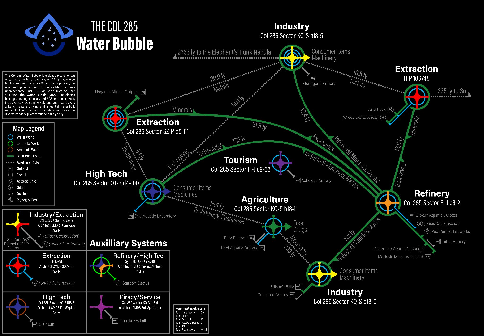
Colonization is the most recent substantial feature added to the world of Elite: Dangerous, having been initially released in beta with the Trailblazers Update on February 26 2025.
Colonization is, simply, being able to build facilities in a new system, claiming it for humanity and expanding humanity’s influence across the galaxy. As the architect of a new colony, your name will be permanently recorded in the Elite Dangerous galaxy as the person responsible for this feat.
Colonization is described by FDEV as in “beta” phase despite being released into the live environment. It has seen several major overhauls and numerous bug fixes since its launch, and may very well see others over time. We will try our best to keep this document up to date; the changelog on the front page should give you an indication of what was updated and when.
As you explore whether Colonization in Elite is for you, the first-order question to ask yourself is: Why? Why should you do it? What’s in it for you? Why do others do it? What’s the purpose or reward of Colonization in Elite?
The reasons to pursue colonization in-game vary, but generally fall under four categories:
- The intent to “paint the map” by adding to the persistent universe of Elite: Dangerous while having naming control over new facilities being created.
Arguably the most commonly-quoted reason for individuals and groups to embark on colonization efforts is to “paint the map” in a novel manner.
Colonization allows CMDRs (and the communities they affiliate with) to:
- Build new facilities in many (but not all - as some are ineligible for a variety of reasons) previously-uninhabited systems
- Name said facilities (either by selecting one of multiple randomly-rolled names, or, by paying a fee in ARX, with a custom name)
- (Subject to an ARX fee) Customize said facilities with custom liveries
Control over “landmark” or otherwise highly-desirable systems can be coveted and can occasionally spark significant competition.
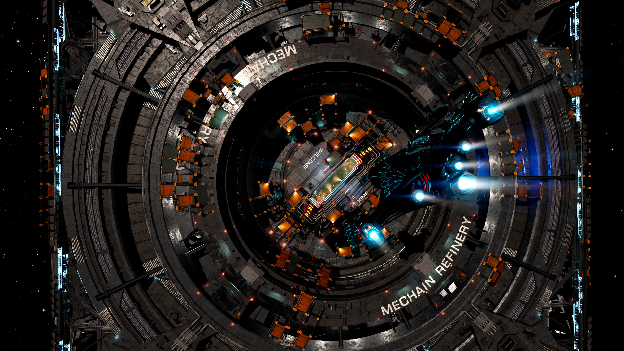
A Pre-Deployment “Under Construction” Coriolis Spaceport
- The intent to create (or bolster) local market economies in locations across the galaxy where none previously existed (or were very limited)
Colonization allows CMDRs to create new markets and shipyard / outfitting facilities in their preferred areas of the galaxy.
For example, the Anti-Xeno Initiative and Xeno Strike Force built a fully-stocked military/ hi-tech set of facilities in Pleiades Sector MI-S B4-0, as a way to locally provide for universal base, repair and outfitting options in the Pleiades Nebula. This means new AX commanders can build and repair ships locally in the systems best suited for learning AX combat, eliminating the need to return to the bubble (for anything other than tech-broker-specific modules or engineering.)
A Player-Built Orbis Spaceport in Direct Orbit of a Star

- The intent to reap the gameplay rewards (which, at the time of writing, are very limited) of being a system architect
- Colonization grants you (somewhat underwhelming) weekly credit payments5
- It is likely that an architected system will be paying well short of 1m credits per week
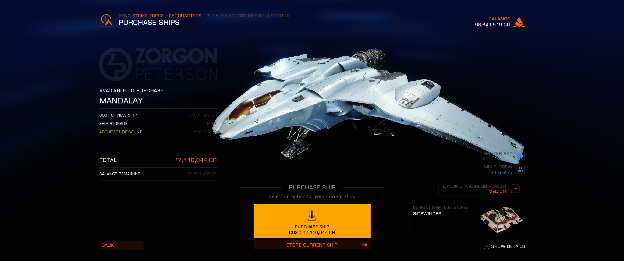
- Colonization also grants you, after a 10th installation is built in a system for which you were the architect, a 3% discount on all ships and outfitting purchased in such system
- This discount stacks with powerplay-controlled discounts (but note this discount applies to the system architect ONLY)
- Colonization pays you a small premium in credits (vs global market average) for commodities delivered to construction sites
- Note: While the default profit paid by construction carriers and construction sites is generally considered underwhelming for the invested time required, hauling for CMDRs who are offering contracts to enlist help from other CMDRs can in turn be HIGHLY profitable; such offers can be found through Inara or through discords such as the Fleet Carriers Owners Club (FCOC) and the Pilots Trade Network (PTN).
The rewards above are less profitable than other activities available at this stage of a CMDR's journey, which is why this isn’t a common motivation for players to embark on Colonization efforts.
Weekly Game Mail for System Architect Credit Rewards
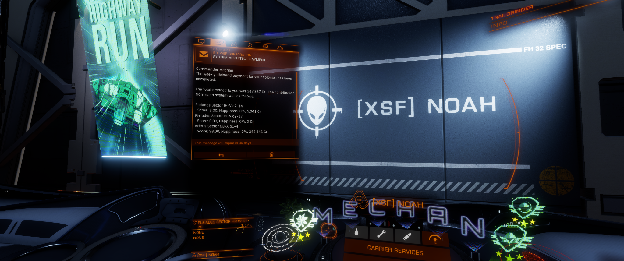
The 3% Architect Discount On Ships And Modules Isn’t A Game-Changer
- Any other personal intent, which may not fall in one of the three typical ones listed above but, Elite being the sandbox game which it is, is no less valid!
Whether you want to recreate Minmus from Kerbal Space Program in Elite, and build an Ice Asteroid base as an “Ice Cream Freezer” to store the mint cream ice cream purportedly mined from said planet, or for any other meme or personal creative initiative you may have - Colonization allows you to set your imagination free and create to your heart’s content.
Elite, at its heart, is the ultimate sandbox space opera. Colonization adds one more degree of freedom to tell your own stories within it.
A Player-Built Ice Asteroid Base (Note: logo has been photoshopped in)

It’s also worth noting that colonization can have certain (often unintended) downsides.
-
Colonizing a system introducing HUMAN signal sources, which compete with NON-HUMAN signal sources for spawns. Effectively, colonizing a system pushes a significant portion of Thargoids out of a system. While narratively most would see this as an upside, it is undeniable that, from a gameplay perspective, this fact can occasionally be undesirable.
-
Introducing newly colonised systems around existing systems increases the potential target range for missions. This means, for example, where systems had been used in the past to progress reputation with certain faction for the purposes of unlocking ships (e.g., Robigo and Sothis) - federal or imperial - the larger number of potential target systems means a wider spread, so less efficient, yield of mission targets.
-
Similarly, certain optimal systems for massacre-mission-stacking will lose the ability to direct to a common target system, to the detriment of those who were using that technique for credits.
-
Last but not least … Thargoids sent Titans to contain human expansion. Who knows how they will respond to the dramatic expansion the bubble is undergoing?

What Do You Need To Get Started?
The initial requirements for Colonization are deceptively low. All you need to make a claim is to pay 25m credits upfront and off-you-go to deploy your first system colonization beacon …
What you will quickly realize however is that, more likely than not, you will also need a pretty decent hauler - ideally a Type 9, or a Type 8 if the former isn’t an option somehow, reasonably equipped to handle the enormous amount of hauling required to build even a tiny little outpost. Here are a few suggested builds, in increasing order of effectiveness, in case you want some inspiration:
- Type 8 unengineered - https://edsy.org/s/vDHweZZ
- Type 8 engineered - https://edsy.org/s/v7gQC59
- Type 9 unengineered - https://edsy.org/s/vfgyQFe
- Type 9 engineered - https://edsy.org/s/vkBT51e
- Imperial Cutter6 - https://edsy.org/s/vUrBFzG
- Panther Clipper Mk2 - https://edsy.org/s/vbis4Ys
The hauling requirements mean that Colonization is more geared towards mid-game players and beyond.
Building anything other than a tiny personal system is furthermore something that requires late game resources (such as a carrier, an engineered large hauler, and ideally even funds to pay other people to load said carrier!), a coordinated group of players working together, and/or a very significant personal time commitment!
In short, you should feel free to experiment with Colonization whenever you feel you have 25m credits to spare, a decent enough hauling ship, and some time on your hands in the following four weeks.
To get serious about Colonization however, you should likely first buy a carrier, save up sufficient funds to equip it and keep it running, then engineer a large hauler and, if that fits your playstyle, also consider joining a larger in-game community which could help.
How To Claim A System? Bridging, Claiming, And The Exclusivity Period
Scouting a system to colonize is generally the first step in the process; we’ll get into what specifically to look for later on, after we explain how economies work.
Scouting a system beforehand and looking for the (Flag) slot visible in the System Map (when it's working) to see where the Primary Port is located is also a sensible thing to do - as it plays into the decision what Primary Port to pick when establishing the Claim later.
You may also want to Detail-Surface-Scan planets of interest to confirm if they have biologicals, geologicals, and/or volcanism - as these factors affect how well-suited planets are for certain economies.
Once you’ve eyed an available system, the next step is to go ahead and claim it. There are four steps in such process:
- Finding a Colonization Contact
- Making the Claim & Selecting the Primary Port
- Deploying the System Colonization Beacon
- Building the Primary Port
“Bridging” is a special case with regards to making long-range claims.
The "Exclusivity Period” refers to the initial 30 minutes (for the system architect) and following 23.5 hours (for the Architect’s squadron) after a primary port is completed, whereas such individuals have the sole right to make a new claim from the newly-constructed port. After said period, anyone can make claims from said port.
Finding a Colonization Contact
Claiming a system is something you perform at a newly-introduced “system colonization contact.” The following systems have such contacts:
- Systems in the “bubble” (the inhabited are centered roughly on Sol, Achenar, Allioth)
- Systems architected by players, where the primary port has been completed
Colonisation originates from the bubble and grows outwards. Inhabited systems OUTSIDE of the bubble, which are not colonized by players, do NOT have colonization contacts. It is not possible to colonize directly from, say, Colonia or the Witchhead Nebula.
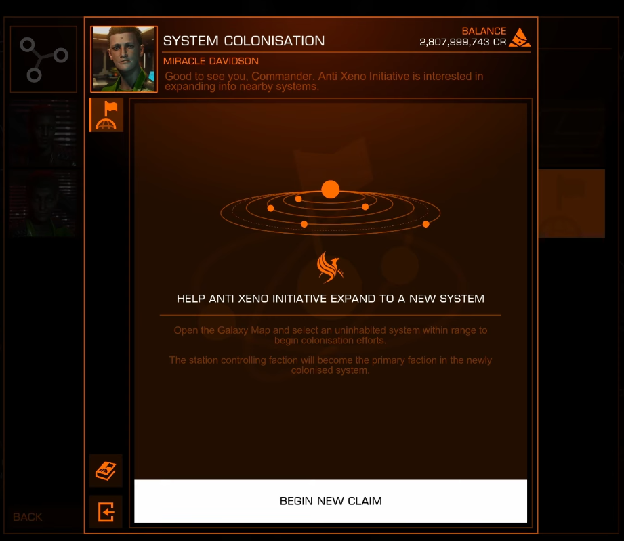
System Colonization Contact: Initial Interface
Making a Claim & Selecting the Primary Port
A claim costs a one-time fee of 25 million credits. Such fee is NOT refunded if the claim is ultimately unsuccessful (more on this later) or canceled.
Claims can be made up to 15.00 Light Years from the location of the colonization contact.
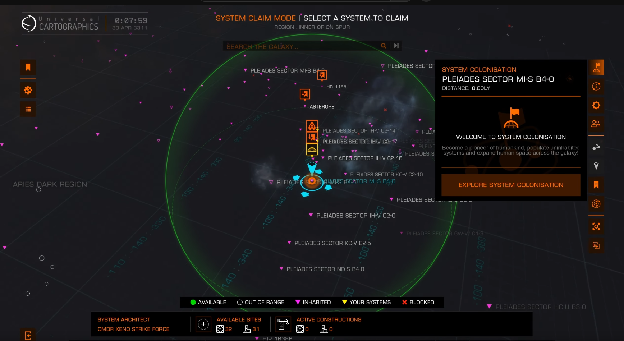
Beginning a new claim brings up a special interface on the galaxy map view with a green sphere showing the claim range from the current location. Eligible systems will light up as bright green dots. If no systems are eligible, there will be no green dots, like in the view below.
System Colonization Contact: The Claiming View
Selecting a green-dot (eligible) system triggers the process of selecting a primary port. Note: The factors governing how to select a primary port are very complex and discussed in a separate section of this document.
IMPORTANT: The primary port of a system is the ONLY facility which can NEVER be changed once built (it can only be canceled or abandoned before it is built.) Choose carefully, as you will NEVER be able to go back on that decision once the port is fully in place!
Once you confirm your primary port choice, you will be awarded a System Colonization Beacon and can move on to the next step.
How BGS Factions Operate In Colonization Affairs
The system you colonize from DOES matter inasmuch you will bring along the system’s primary faction with you - and it will become the target system’s primary faction. So if, for example, you don’t want to architect a system run by an anarchy faction, you should avoid colonizing from systems that have an anarchy faction in control.
Note: When a player is in a squadron and this squadron is associated with minor power, the factions of your colonized system will be as follows:
- 1st - (60%) Controlling faction of the station from which player takes the claim
- This is often, but not always, the system’s controlling faction
- 2nd 7- (20%) The controlling faction of the system from which you made the claim (if it was NOT the same faction controlling the station you made the claim from) OR the 2nd faction by influence in the same system (if station and system controlling factions are the same)
- 3rd - (13%) The faction that is aligned with your squadron
- If a player is not in a squadron, this third faction is taken from a nearby system; the specific mechanics of how said third faction is chosen in this scenario are presently unknown
- 4th - (6%) An anarchy faction which is taken from the closest system where it is already present - this applies also in case the ruling faction is already of Anarchy type
As changing control factions after-the-fact is extremely painful (requires weeks of BGS wars, etc.) you may want to think carefully about your source colonization contact’s affiliation.
It’s worthwhile to also mention that factions with the government type of Anarchy also have a role to play for your system-building efforts:
- Anarchies and Dictatorships are the ONLY government type which can produce Combat Stabilizers (at high-tech ports), and one of only THREE which can produce Battle Weapons (at industrial, high-tech, and military ports.)
- Anarchies are the ONLY government type which can offer ALL ships up for sale in a shipyard (assuming system tech level is high enough)
- Anarchies, as everyone knows, throw the best parties 🙂 [have “anarchy” as system security level]
Deploying the System Colonization Beacon
A Mandalay drops a system colonization beacon
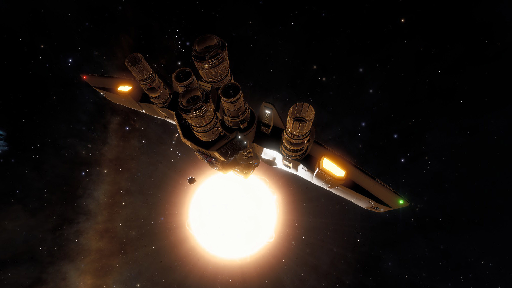
Having made the claim, you now need to jump to your target system, fly to the market system colonization beacon drop-off location, and deploy said beacon. Note - you will first need to assign the colonization beacon to a firegroup in your ship’s right panel to complete this step. If the drop-off location does not appear, check your left-panel filters and make sure “points of interest” is checked. It’s also possible to assign a hotkey for System Colonization Suit (SC suite):
- Option->Controls->Ship Controls->Miscellaneous->System Colonization Suite
You have 24 hours to perform this step or your claim will expire and you (and, in fact, apparently anyone else too8) will be prevented from re-claiming the same system for a subsequent 24-hour period (you can, however, claim a DIFFERENT system in that period).
The system colonization beacon is essentially a proto-nav-buoy, and will convert to a nav buoy proper once you complete the next step in the process. Like nav buoys, these beacons allow you to scan a full system by targeting them and scanning them in local space.
Building the Primary Port
Once the colonization beacon has been deployed, a special system colonization megaship will jump into the system at the primary port’s designated location.
A System Colonization Megaship Jumps Out, Having Completed Its Mission
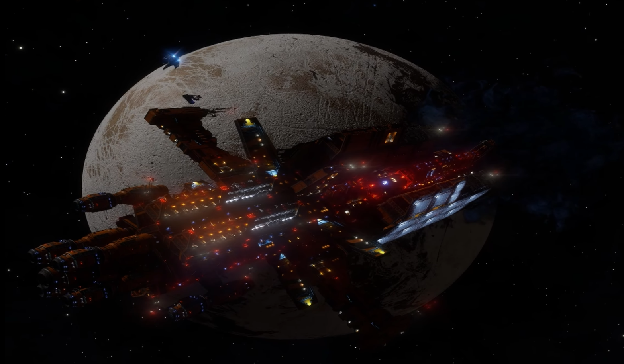
This megaship will act as the drop-off point for materials necessary to build the port.
You will need to haul the required materials to this ship to actively build your primary port.
IMPORTANT: You have 4 weeks to perform this step or your claim will expire and you will be prevented from re-claiming the same system.
Once you have hauled the necessary materials, a Brewer Corporation screen will appear confirming construction is complete. Your new facility will immediately appear nearby, and the colonization megaship will jump out a couple of minutes later.
Congratulations! You are now permanently recognized as the System Architect of your newly-colonized system, and no longer “on the clock” for any of your subsequent build activities in the system.
Bridging Towards Far-Away Claims
As mentioned, the claim range from any given colonization contact is a meager 15 light-years. But what happens if your dream system is further away than that?
In order to “reach” said system, you will need to build one or more “stepping-stone” outposts, where you claim a system, build a tiny space outpost, then immediately claim the next system in the chain and rinse-repeat until you reach your destination. The community has come to call this chain a “bridge” and the act of building this chain of systems, “bridging.”
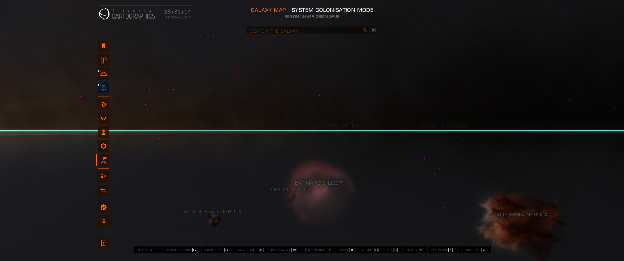
To “design” the map of such a bridge you can use the Spansh Colonization Plotter.
Some community-built bridges stretch hundreds of systems long!
The Fatherhood community built a bridge over 500 LY long to reach and colonize the California Nebula
The Exclusivity Period
The patch notes from 4.4.1.2 explain the exclusivity period very well:
- Introduced new functionality to prevent 'claim sniping'. When the primary port is completed in a newly colonised system, an exclusive lock on making claims FROM that system's colonisation contact will be enforced for a short period
- The System Architect may exclusively make claims from the system for 30 minutes
- After this 30 minutes expires, anyone within the System Architect's Squadron may make a claim for the next 23.5 hours
- This will function even if the System Architect is in their own solo Squadron
- After a total of 24 hours, the exclusive claim rights lift and any player may make a claim from the newly constructed system
- Note that if the System Architect is not in a squadron, then only the 30 minute lockout applies.
- The claim panel via the colonisation contact has been updated to display when a lockout is in effect, and details the remaining duration
The exclusivity period effectively resolves the issue with claim sniping that plagued Trailblazers for the first months of its release.
Other CMDRs may still race you to that desirable ringed Earth-like world - but they will now have to build their own parallel bridges to compete (which is fair - and unlike claim sniping, which was not).
If you are a solo builder and are worried about claim sniping, you may want to create a 1-CMDR squadron as that gives you a full day (instead of just 30 minutes) of claim sniping protection. It’s a worthwhile investment if you’re into colonization and playing alone!
How To Architect A System? Construction Points, And A Tool You Will Love
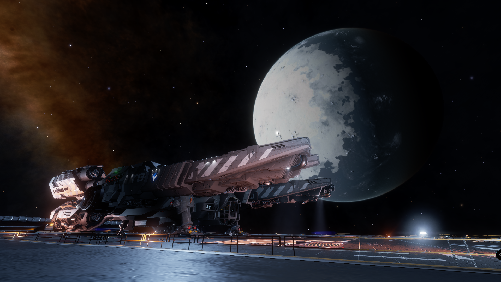
Water Worlds, while rare, enable great space farms (Image Credit: CMDR Arryn Royce)
Introduction To Building Up A System
First things first - an important reminder from the sections above:
IMPORTANT: The primary port of a system is the ONLY facility which can NEVER be changed once built (it can only be canceled or abandoned before being built.) Choose carefully, as you will NEVER be able to go back on that decision once the port is fully built!
This section assumes that you have successfully constructed a primary port, and are now looking to add more facilities to your system.
There are, broadly, four types of facilities that a player can build in Elite: Dangerous:
- Ports (which come in both orbital and planetary variants)
- [Planetary] Settlements
- [Planetary] Hubs
- [Orbital] Installations
Facilities are furthermore “Tiered” into three tiers, using a logic that goes:
- Tier 1 facilities - cost no construction points, generate tier 2 construction points
- Tier 2 facilities - cost tier 2 construction points, generate tier 3 construction points
- Most Tier 2 facilities cost one yellow CP and generate one green CP; the exception are large settlements (which cost one yellow CP and generate TWO green CPs) and Tier 2 spaceports (Coriolis and Asteroid Bases - which cost three+ yellow CPs and generate one green CP)
- Tier 3 facilities - cost tier 3 construction points, do not generate any construction points
Because the terminology in-game around this is nothing short of horrifically confusing, with “Tiers” referring to either facilities or different types of construction points, in this guide we will use “Tier” to reference exclusively to a facility’s tier, and “Yellow [Construction] Points (Tier 2)” and “Green [Construction] Points (Tier 3)” when talking about CPs.
So, for instance, we will say “a Coriolis station is a Tier 2 spaceport which, at baseline, requires three yellow CPs and generates one green CP.”
Before You Start: CP-Cost Increases For Tier 2 And Tier 3 Ports
Another critical piece of information you need to be armed with before you go about planning your system, is that the “cost” in terms of CPs of Tier 2 and Tier 3 ports INCREASES as soon as the second such port is laid down for construction. This increase gets higher and higher as additional T2/T3 ports are laid down. Ports do not need to be completed for the increase to “kick in” - merely initiating construction results in the increase for future ports. Materials cost remains the same despite the CP cost increase.
Note that the Primary Port DOES NOT COUNT towards such limit - and such exception has important implications with regards to primary port selection, which we will get into in the relevant section.
Also note that this mechanic is exclusive to T2 and T3 ports (both spaceports and the T3 planetary port.) T1 ports are exempted and so are all installations, settlements, and hubs.
The cost increase works as follows:
| Port Tier | 1st T2/T3 Port9 | 2nd T2/T3 Port | 3rd T2/T3 Port | 4th T2/T3 Port | 5th T2/T3 Port | Nth T2/T3 Port |
|---|---|---|---|---|---|---|
| T2 (Coriolis, Asteroid Base) | 3 T2 Points | 3 T2 Points | 5 T2 Points | 7 T2 Points | 9 T2 Points | 3+(n-2)*2 T2 Points |
| T3 (Orbis, Ocellus, T3 Plan. Port) | 6 T3 Points | 6 T3 Points | 12 T3 Points | 18 T3 Points | 24 T3 Points | (n-1)*6 T3 Points |
The mechanic above has MAJOR implications for system architecting; in particular:
- It severely limits the total number of T2/T3 ports which can be placed in a single system
- Your first two T3 ports require a minimum of 6 supporting facilities each (to generate enough green CPs) to construct; your fifth T3 port requires no fewer than 30 supporting facilities before it can be constructed
- For systems you or (more typically) your community intend to significantly build-up, it strongly encourages building a T3 as Primary Port
- The Primary Port does not count towards the limit, and requires no CPs to construct and thus no “supporting” facilities in the system
- It strongly encourages building T3 ports BEFORE T2 ports
- The cost of T3 ports increases by 6 T3 points each step, while the cost of T2 ports only increases by 2 T2 points each step; see these two examples in practice:
- Sequence: T2, T2, T3, T3
- Cost: 6 Yellow CPs, 2810 (!) Green CPs
- Minimum supporting facilities to build: 36
- Sequence: T3, T3, T2, T2
- Cost: 16 Yellow CPs, 12 Green CPs
- Minimum supporting facilities to build: 28
- Sequence: T2, T2, T3, T3
- The cost of T3 ports increases by 6 T3 points each step, while the cost of T2 ports only increases by 2 T2 points each step; see these two examples in practice:
- It makes T1 civilian planetary ports acquire a special value
- The T1 Civilian Planetary Port is the only large-pad-colony-type-facility which isn’t subject to this mechanic
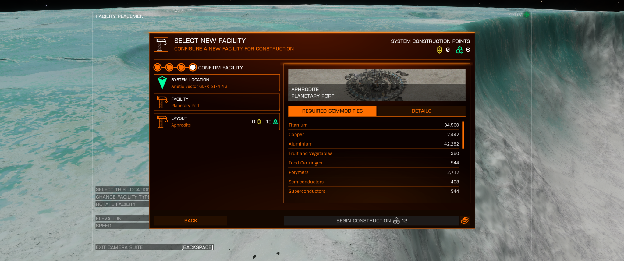
Tier 3 Planetary Port Construction View - Showing The Green CP Cost Increase (From 6 to 12)
How To Effectively Plan For System Construction
Two near-essential tools for colonization planning are available here; both are great tools:
- Raven Colonial: https://ravencolonial.com/#home
Raven Colonial web interface
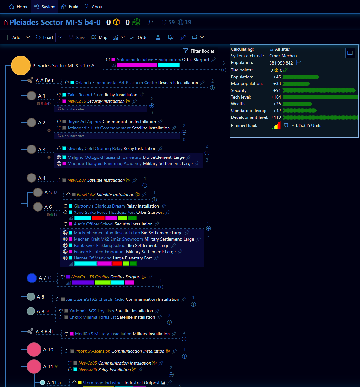
Raven Colonial is a fantastic tool to design and plan your system in a web browser. Raven Colonial video tutorial is available here.
- CMDR DaftMav’s Spreadsheet: DaftMav’s Colonization Construction Spreadsheet
Primary View of DaftMav’s Colonization Construction Spreadsheet
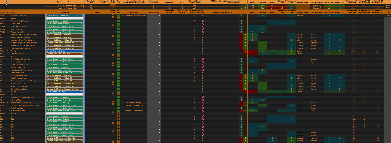
DaftMav’s spreadsheet will allow you to “simulate” building up your system exactly the way you want it, while also highlighting dependencies and construction point requirements.
Generally speaking, past your primary port, construction goes as follows:
- You build Tier 1 facilities to generate Yellow CPs
- While some Tier 1 facilities have economic-shaping effects, they tend to be much weaker than comparable Tier 2 facilities in this regard
- You build Tier 2 facilities to convert Yellow CPs into Green CPs
- Tier 2 facilities are also used to specialize your economy
- You build Tier 3 facilities by spending the Green CPs you generated
- Tier 3 facilities have the best statistics overall and on a per-slot basis
In the long run, most economy types have value for the purpose of colonization and expansion. That being said, given the disproportionate demand of steel, titanium, aluminum, and other refinery-produced materials, refineries tend to be the first system built by players when “building up” a new cluster of systems, as the metals they produce greatly boost the ability to construct all other facilities.
In terms of architecting systems, keep in mind you can initiate construction of up to five facilities at the same time. Once you have done that, you will need to complete said facilities before you are allowed to lay down more for construction.
In terms of facilities, think hard before you build “small” settlements, as the cost of “medium” settlements isn’t all that higher and the benefits medium ones provide are generally better.
The specific statistics provided by individual facilities also matter, we will get into these later in this document.
The rules governing how economies interact changed significantly in patch 4.2.0.1, with the patch notes describing the change as follows:
“Improvements have been made to how colonisation built constructions produce and consume goods - the goods produced by the top two economies will no longer be consumed by ports or settlements linked to that economy.”
- “This is intended to resolve instances where economies would 'cannibalize' each other via market links, which previously resulted in limited or zero goods being available at a commodity market.”
The implication of the change above is that, in general, you will likely want to be designing stations with one or two primary markets, and with as few influences from additional markets as possible, to avoid the “cannibalization” of demand and supply which every market from the third onwards introduces.
Anvil’s Pride is a refinery built for the purpose of providing metals to build efforts across the Pleiades

The Value Of Space Versus Ground Slots
Ground slots and space slots both have their uses - but some things can only specifically be done in one type or the other, or are preferable in one location over the other.
In favor of space slots:
- Coriolis, Orbis, and Ocellus starports are by far the most convenient markets a player can build, as they have large pads, and are not subject to the tedious and slow process of approaching a planet and gliding to a planetary port
- Contraband market strong-links can ONLY be created using orbital facilities (pirate base)
- Certain commodities (e.g., Insulating Membranes) are restricted to being produced at orbital starports
In favor of ground slots:
- Certain commodities (e.g., CMM Composites) are restricted to being produced at planetary sites exclusively
- Tier 3 Planetary Ports have the best statistics of any facility in the game
- “Large” Tier 2 settlements are the ONLY type of facilities able to convert a single yellow CP to TWO green CPs; every other facility converts them at 1:1 ratio (or worse, for starports)
- Ground facilities can be built very close to each other (the minimum distance between facilities is 200km); this can make delivering “low volume” construction materials across multiple sites faster when building multiple facilities at once
- Refinery markets can ONLY be specialized by using the ground-exclusive Refinery Hub
- Hubs in general, which are planetary-only, are among the best facilities to specialize an economy while also having excellent system-wide bonus stats, and functioning as a prerequisite for certain features being available in ports
Naming And Customizing Your Facilities
Facilities can be renamed either using a randomly-rolled name or (by paying 5,000 ARX, once for each individual facility) be given a player-defined name. A facility can be renamed from anywhere in the galaxy, using the architect interface in the system map.
For randomly-rolled facility names:
- You can “reroll” a name an unlimited number of times, until you see one that inspires you
- You can “reassign” a name to a facility a maximum number of five times overall (so choose wisely)
For player-defined names:
- The name of the facility must be unique in the system (but can be the same as facilities in other systems)
- Several special characters are disallowed - notably the apostrophe, but also several other types of punctuation and parentheses
- Several strings of text will be disallowed as potentially offensive; Note: this filter can be sometimes overly aggressive
- Once bought for ARX, the name of that individual facility can be changed an unlimited number of times by the player
Facility names are generally updated during the weekly server downtime on Thursdays for ports, and immediately for other facility types.
5,000 ARX will unlock custom renaming and unlimited-renaming for a facility, subject to limitations
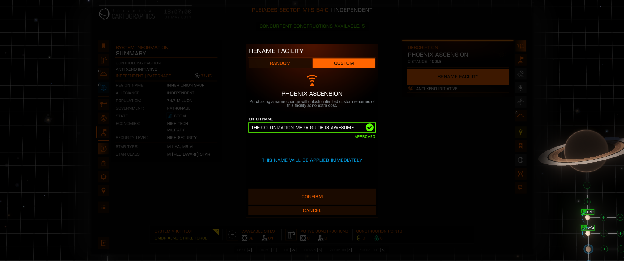
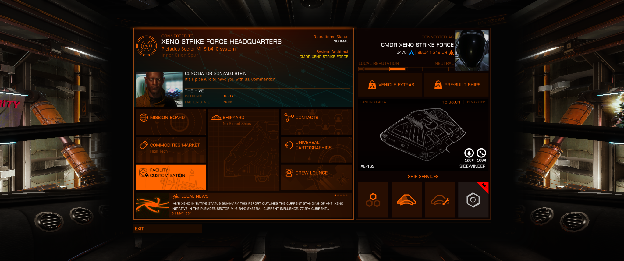
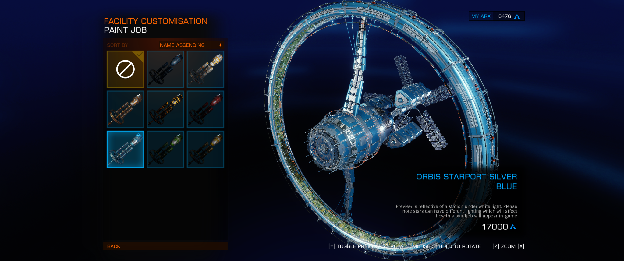
Custom liveries are also available for stations to change their color scheme. You need to be docked at the station you want to change the livery of and be the system architect for you to be able to change a station’s livery. It cannot be done remotely.
Station livery-change option only appears when docked as the system architect
Vanity doesn’t come cheap
Station Interiors
Note: This section was written by CMDR Raghav102. You can reach him with comments or questions at the Discord handle “raghav102”.
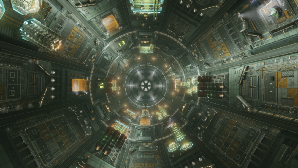
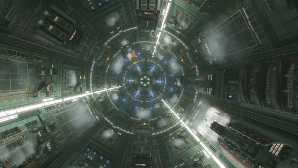
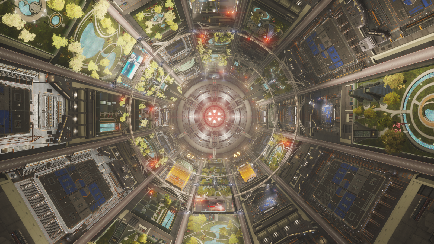
Since update 3.3 ports also acquire the interior layout style that matches their primary economy type.
Station interiors behave as follows:
-
Interiors update only on weekly maintenance.
-
Only T2/T3 Orbital Ports can have their interiors changed. (Coriolis, Ocellus, Orbis)
-
To get an interior, the game uses the economy with the highest proportion. If there are multiple economies with the same proportion, the first economy in alphabetical order is selected for the purpose of determining interiors.
- It's possible to have a station with the interior of a certain economy, but the displayed economy is different. Example: Station with 140% High Tech and Tourism proportion. The displayed economy on the commodity market description is Tourism, but the interior is High Tech.
-
There are 2 ways to check economy proportions, listed below.
- Find your station on inara.cz, it will list your station’s proportions of economies in percentages.
- Search your journal files and search for the “Docked” event. Read the rest of the line until you find the economy and proportions of each. Journal files are usually found in the following directory: C:\Users\<User>\Saved Games\Frontier Developments\Elite Dangerous.
-
Some interiors are subject to lighting changes based on superpower allegiance. This is determined by the allegiance of the minor faction controlling the station. Allegiance can be easily checked by selecting a station in the system map and looking at the icon right before the faction name (displayed right under the name and distance). Icons shown below:
Federation Alliance Empire Independent


Note: The community-given names below of these interiors have no relation to what economies spawn them, which are rather listed below the images.
| Federation | Empire |
|---|---|
 |  |
| “Agriculture” Interior | |
| Alliance | Independent |
 |  |
| Port Type | Economy Required |
| Pre-Trailblazers Ports | Agriculture |
| Colonized Ports | Agriculture |
| Federation | Empire |
|---|---|
 |  |
| “Industry” Interior | |
| Alliance | Independent |
 |  |
| Port Type | Economy Required |
| Pre-Trailblazers Ports | Extraction OR Industrial OR Refinery |
| Colonized Ports | Extraction OR Industrial |
| Federation | Empire |
|---|---|
 |  |
| “Neon” Interior | |
| Alliance | Independent |
 |  |
| Port Type | Economy Required |
| Pre-Trailblazers Ports | High Tech OR Military |
| Colonized Ports | High Tech OR Service |
| Federation | Empire |
|---|---|
 |  |
| “Refinery” Interior | |
| Alliance | Independent |
 |  |
| Port Type | Economy Required |
| Pre-Trailblazers Ports | N/A |
| Colonized Ports | Refinery |
“Tourist” Interior (Note: This interior has no variants)
| Port Type | Economy Required |
|---|---|
| Pre-Trailblazers Ports | Tourism OR Service |
| Colonized Ports | Military |
“Wealthy” Interior (Note: This interior has no variants)
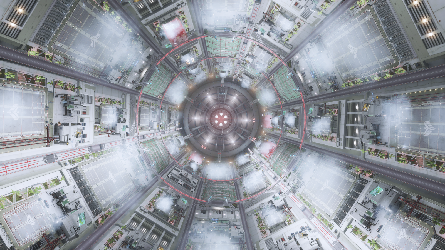
| Port Type | Economy Required |
|---|---|
| Pre-Trailblazers Ports | Specific Ports only. Not Economy based. |
| Colonized Ports | Tourism |
“Standard” Interior (Note: This interior has no variants and is not available in colonized systems)
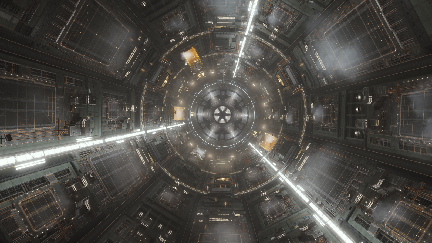
| Port Type | Economy Required |
|---|---|
| Pre-Trailblazers Ports | Industrial OR Terraforming |
| Colonized Ports | N/A |
Canceling And Deconstructing Facilities
Colonization contacts also let you cancel in-progress primary ports before completion
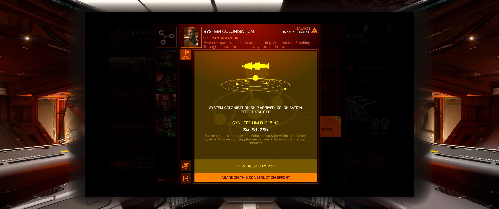
The construction of all facilities, with the notable exception of a system’s Primary Port, can be canceled before being built, and can be deconstructed after they are completed. Primary ports can be canceled before being completed, but CANNOT be deconstructed after being completed.
Note that any ARX spent to rename demolished facilities are NOT refunded and are “lost”.
The patch notes for 4.2.1.0 explain how the process works:
System Colonisation construction efforts and fully constructed facilities can now be demolished or cancelled.
- Facilities and construction efforts marked for demolition will be removed on the following weekly maintenance
- After marking a facility or construction effort for demolition, the system architect can cancel the demolition any time before the next weekly maintenance
- The primary/initial port in a colonised system cannot be demolished
- Slots and construction points are refunded on demolition during weekly maintenance
- Tier 2 and 3 construction points can go negative in the event a commander demolishes facilities that earned those points whilst also keeping the tier 2 or 3 facility that used those points
- Facilities that depend on another type to be constructed need to be demolished first before demolishing the parent facility
- For example: A relay station is needed in the system in order to construct a security station, so the security station needs to be demolished on the weekly tick before the relay station can be marked for demolition the following week. If there are 2 relay stations however, one of them can be demolished since there is another to maintain the dependency
- Any missions that were accepted at a facility that is later demolished will be deleted along with the facility during weekly maintenance
- Any commodities put into a construction effort that gets cancelled will be lost and not refunded
- Neither custom renaming rights nor the ARX cost will be refunded if a station they were bought for is demolished
Demolish interface - which also uniquely shows you the facility type
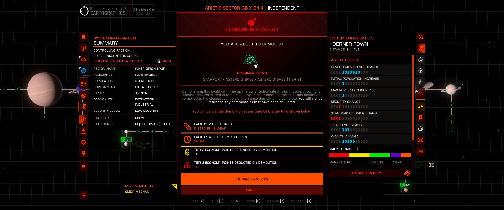
Enabling Services At Ports
Services (like shipyard, outfitting, etc.) have specific requirements since update 3.3 in order to come online at your port.
Note that, for black markets in particular, the controlling-faction ethos overrides the table below; the presence or lack of black markets is overwhelmingly dependent on the controlling faction, much more so than on any colonization build effort. Finally, note that Black Markets being opened by a controlling faction also forces the commodities market to open, also overriding the table below.
Rules are as follows:
| Port | Commodities Market | Shipyard | Outfitting | Universal Cartographics | Vista Genomics | Black Market | Crew Lounge | Pioneer Supplies |
|---|---|---|---|---|---|---|---|---|
| Tier 3 Port | Always Active | Always Active11 | Always Active | Always Active | Strong link to a Pirate Installation | Always Active | Always Active | |
| Tier 2 Port | Strong link to a Satellite Installation, Comms Installation or Relay Station or Scientific Installation or Exploration Hub built in system | Always Active | ||||||
| Commercial Outpost | Always Active | Not Available | Strong link to an Industrial Hub or Military Installation or High Tech Hub built in system + Tech Level 35 | Not Available | Bar Installation built in the system | |||
| Industrial Outpost | ||||||||
| Civilian Outpost | Always Active | |||||||
| Criminal Outpost | Strong link to a Comms Installation or Relay Station or Tourist Installation or Bar Installation or Outpost Hub in the same system | Always Active | ||||||
| Scientific Outpost | Always Active | Strong link to a Pirate Installation | Bar Installation built in the system | |||||
| Military Outpost | Tech Level 35 | Strong link to a Satellite Installation, Comms Installation or Relay Station or Scientific Installation or Exploration Hub built in system | ||||||
| Tier 1 Planet Port - Civilian | Always Active | Strong link to a Comms Installation or Relay Station OR Tourist Installation or Bar Installation or Outpost Hub in the same system IN ALL CASES also needs Tech Level 35 | Strong link to an Industrial Hub or Military Installation or High Tech Hub built in system + Tech Level 35 | Always Active | Always Active | |||
| Tier 1 Planet Port - Industrial | Tech Level 35 | Bar Installation built in the system | ||||||
| Tier 1 Planet Port - HiTech | Strong link to a Comms Installation or Relay Station OR Tourist Installation or Bar Installation or Outpost Hub in the same system Strong link to a High Tech Hub or Military Installation or Industrial Hub built in system | Strong link to an Industrial Hub Military Installation or High Tech Hub built in system + Tech Level 35 | ||||||
| Research Bio Settlements | Always Active | N/A | N/A | Always Active | N/A | N/A | N/A | N/A |
| All Other Settleme nts | Always Active | N/A | N/A | N/A | N/A | N/A | N/A | N/A |
For black markets, as mentioned above, the controlling faction of a given port (not system!) is what primarily dictates their presence:
- Open: Social and Criminal ethos
- Most Anarchy, Communism, Confederacy, Cooperative, Democracy, and Theocracy
- Close: Corporate and Authoritarian ethos
- Most Corporate, Dictatorship, Feudal, Patronage, and Prison Colony
Ordinarily ethos is predictable from the government types above, but some factions - often but definitely not exclusively older Player-Managed Factions - have an atypical ethos. So it is possible that things won’t match the list above exactly.
How Do Colony-Type Ports Gain Economies? Base Inheritable Economy + Modifiers
Ports come in two families:
| Colony-Type Ports | Specialized Ports | |
|---|---|---|
| Tier 1 | [Orbital] Civilian Outpost, [Orbital] Commercial Outpost, [Planetary] Civilian Outpost | [Orbital] Industrial Outpost [Industrial], [Orbital] Criminal Outpost [Contraband], [Orbital] Scientific Outpost [Hitech], [Orbital] Military Outpost [Military], [Planetary] Scientific Outpost [Hitech], [Planetary] Industrial Outpost [Industrial], |
| Tier 2 | Coriolis | Asteroid Base [Extraction] |
| Tier 3 | Orbis, Ocellus, T3 Planetary Port | None |
Specialized ports are:
- Assigned a baseline economic strength value of 0.5 (industrial/scientific ground ports) or 1.012 (several orbital versions) for their applicable economy type
- NOT affected by the base inheritable economy of the local body
- NOT affected by base inheritable economy modifiers of the local body (rings, biologicals, geologicals)
- Affected by strong and weak links (more on this later) like any other port
Colony-type ports instead follow special rules with regards to the economy type they acquire - which depends on the characteristics of the local body they reside on or orbit. This is in addition to being affected by strong and weak links.
Colony-type ports acquire their economy type(s) as follows:
- The “Base Inheritable Economy” type of the local body they are on or orbit is assessed
- The “Base Economy Modifiers” applicable to the local body are applied
- The economy type of the Colony-type port is replaced by the combination of the two factors above
Frontier Developments described these factors in a forum post available here: https://forums.frontier.co.uk/threads/elite-dangerous-trailblazers-update-3-now-live.636973/.
Such post is rather complicated however; we have tried to improve the readability of the information below:
| Local Body Type | Base Inheritable Economies |
|---|---|
| Black holes, Neutron Stars, White Dwarves | HighTech, Tourism |
| Brown Dwarves and all other star types | Military |
| Earth like worlds | Agriculture, HighTech, Military, Tourism |
| Water world | Agriculture, Tourism |
| Ammonia world | HighTech, Tourism |
| Gas giant | HighTech, Industrial |
| High metal content and metal rich world | Extraction |
| Rocky ice | Industrial, Refinery |
| Rocky | Refinery |
| Icy | Industrial |
| Local Body Modifier | Base Inheritable Economy Modifier |
|---|---|
| Has rings (includes stars with asteroid belts) | Extraction |
| Has organics | Agriculture, + Terraforming |
| Has geologicals | Extraction, + Industrial |
Note: The local body modifiers above do NOT stack with base planet economies, NOR do they stack with each other. This is best illustrated with a few examples:
- A colony-type port on an Icy planet with geologicals will have an industry value (before any other modifiers) of 100%, NOT 200% (planet intrinsic and geologicals are NOT added to each other - they overlap instead)
- A colony-type port on a High Metal Content Planet with both rings and geologicals will have an extraction value (before any other modifiers) of 100%, NOT 300% (planet intrinsic and geologicals are NOT added to each other - they overlap instead) and NOT even 200% (rings and geologicals also overlap with each other
Note: Geologicals are the features identified with a Detailed Surface Scanner (or, while in-system, by inspecting the body in the system map) and they are distinct from “volcanism” which is instead a modifier of strong links13 (yes, this is very confusing - but an important distinction!).
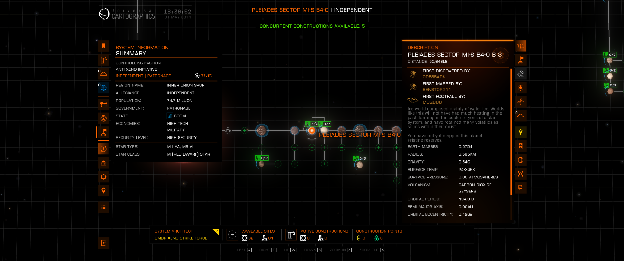
Volcanism, such as Carbon Dioxide Geysers shown here, is different from “geologicals” as a planet property
The following implications can roughly be derived from the above, in terms of “pure” market-design recommendations:
| Desired Economy Type | Preferred Local Body |
|---|---|
| Extraction | HMC or Metal-Rich Planets, without organics, and without geologicals14 |
| Refinery | Rocky-type planets, without rings, without organics, and without geologicals [Note: Specialized refineries also benefit from as many ground slots as possible (as only Refinery-strong-link-granting facility is the planetary-bound Refinery Hub)] |
| Industrial | Icy Planets, without rings, without organics, and without geologicals15 |
| Military | Main Sequence Stars (and Brown Dwarfs) without asteroid belts |
| Agriculture | Water world16, without rings OR Any non-icy, non-tidally-locked body with biologicals, NO geologicals (and no rings, unless it’s an HMC body - then rings are irrelevant) |
| Tourism | Ammonia world or Water World, without rings, without organics, and without geologicals - OR non-main-sequence-star without asteroid belts |
| HighTech | Ammonia world17 without rings - OR black holes/neutron stars/white dwarfs without asteroid belts |
| Terraforming | Any landable planet with organics |
| Contraband | N/A - No local body provides for Contraband; pick any local body with a single local market type and a good number of space local-market slots; (You’ll need to use strong/weak links to build a Contraband market, and/or use the specialized (Orbital) Criminal Outpost) |
What Are Strong & Weak Links? How Are They Modified By Link Modifiers?
Official Frontier Developments Infographic On Colonization Linking
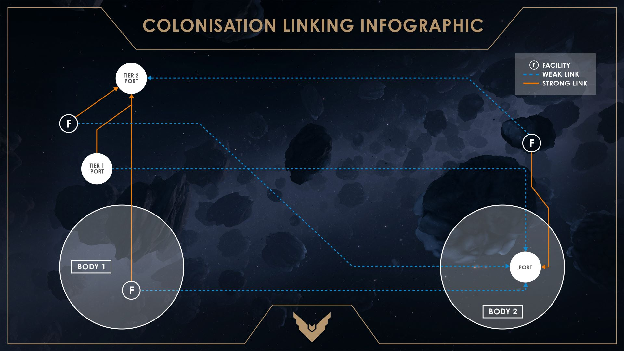
Facilities influence markets using three key mechanics:
- Strong Links
- Strong links are formed within facilities around a Local Body ONLY
- Strong links are subject to strong link modifiers
- Strong links vary in strength based on the facility which generates them (0.4 for Tier 1, 0.8 for Tier 2, and 1.2 for Tier 318, before modifiers); they are always significantly stronger than weak links (0.05)
- Weak Links
- Every facility with an economy type (except ports) generates “weak links” to all ports19 outside of their local body
- Weak links have a fixed value of 0.05 per weak link; this value is NOT subject to any modifier, ever
- Special Case: Port-to-Port Strong Links
- While technically classed as strong links, these are a somewhat special variant of said strong links, and behave differently
Links Are Displayed For The System Architect When Selecting A Port
[Note this is not the full economy of the port! It is Links ONLY]
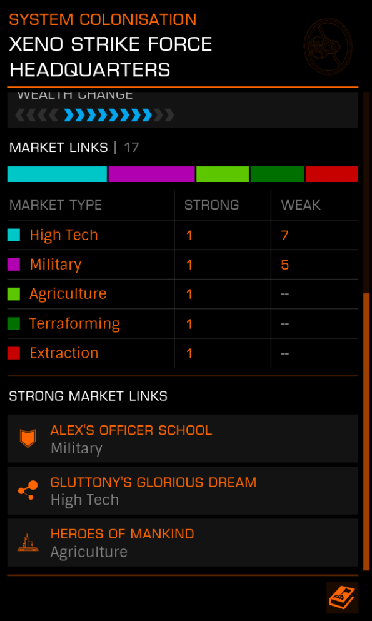
Strong Links
Strong links are likely going to be the primary way you will be specializing and building-up the economy of your system.
Strong links are formed between non-port facilities (FDEV calls them “supporting facilities”) and a port.
At most ONE strong link can be formed between a support facility and a port20 - if there is more than one port in the local body, special rules apply which govern how strong links are formed and “passed on” (see section below.)
If there are no ports in the same local body of a supporting facility, said facility will simply not form any strong links (but will still project weak links to other ports.)
Note that the strength of Strong Links varies: as a general rule, Tier 2 facilities (such as hubs) provide strong links with a higher economy value (0.8) as compared to Tier 1 facilities (such as small and medium settlements, which provide 0.4.)
Strong Links are subject to modifiers which affect them (stacking additively) depending on specific characteristics of the local body, as follows:
| Economy Type | Boosted by: | Decreased by: |
|---|---|---|
| Agriculture | Orbiting an Earth like world Orbiting a Water World [NOTE: PRESENTLY BUGGED - NOT WORKING] On or orbiting a terraformable body21 On or orbiting a body with organics22 | On or orbiting an icy body On or orbiting a planet that is tidally locked to its star On or orbiting a moon that is tidally locked to its planet and its subsequent parent planet(s) are tidally locked to the star |
| Extraction | In a system with major or pristine resources On or orbiting a body with volcanism | In a system with low or depleted resources |
| High Tech | Orbiting an ammonia world Orbiting an earth like world Orbiting a Water World On or orbiting a body with geologicals On or orbiting a body with organics | Nil |
| Industrial & Refinery | In a system with major or pristine resources | In a system with low or depleted resources |
| Tourism | Orbiting an ammonia world In a system with a black hole Orbiting an earth like world On or orbiting a body with geologicals On or orbiting a body with organics Orbiting a water world In a system with a white dwarf In a system with a neutron star | Nil |
While additional research is necessary, it would appear that “boosting” entails a flat +0.4 bonus (so a raw 0.8 value becomes 1.2) and “decreasing” entails a -0.4 malus (so a raw 0.8 value becomes 0.4), noting that strong link “strength” cannot be decreased to below 0.1.
Weak Links
Weak links are established between non-port facilities and all non-local-body ports across the system. A single facility can create weak links to an unlimited number of ports in the system.
The strength of weak links is always 0.05 and is not subject to any kind of modifier.
The Weak Link mechanic is the primary reason we recommend specializing SYSTEMS instead of BODIES - as a given type of facility ANYWHERE in a system will affect ports EVERYWHERE in the system.
Special Case: Port-to-Port Strong Links
TL;DR: Building more than one port on or around a given local body is a bad idea. Don’t do it.
FDEV treats Port-to-Port links as Strong Links, but special rules apply to such links. According to the official documentation, the following logic applies:
[Strong Links] may also be created between ports if there are multiple of this type on or around the same body
- In the event multiple ports are present, the highest tier port will be linked to. If both ports are of the same tier, the port which was built first will be selected
- In the event both a planetary and space-based ports are present, planetary facilities will create strong links with the planetary port, which will pass these strong links on to the orbital port following the same prioritisation rules regarding tier and build order
The specific mechanics of how multiple ports in a local body link to each other are confusing, potentially bugged, and rather clunky - which is why we generally do not recommend building more than a single port per each local body. This is compounded by the equally confusing rules of how strong links are formed when multiple ports are present.
In the present implementation of how this mechanic works, planetary ports have the surprising behavior of passing on to spaceports above them also the inherent economy of the planet they reside on - which is an extremely powerful effect. Having multiple civilian (T1) planetary ports on a rocky planet and a Coriolis above them may result in an incredibly strong market (This is true for a single planetary port to a single spaceport. Whether this is true for multiple planetary ports remains to be verified.).
- We believe this is a bug (tracker link), so exploit it at your own risk - as it may be eventually fixed and you may end up with a pretty-broken system if it is.
Special Case: When Ports Convert To Being Supporting Facilities
Ports, as a general rule, are not considered supporting facilities and, as such, will generally not create weak links with other facilities across the system.
However, if more than one port is built in a local body, the lower-tier ports (or, if same-tier ports are built, the later-built ports) are built on or around a local-body, all but one of them will be converted to supporting facilities:
- If both planetary and space ports exist, all but one planetary ports are converted to supporting facilities, regardless of their tier
- Thereafter, orbital ports follow the rule below
- Note that oldest&top-tier Planetary Ports which connect to Orbital Ports within the same Local Body do NOT fully convert to supporting facilities proper - they DO form strong links with the space port but DO NOT generate weak links to all other ports. These are effectively a special case within a special case. Planetary Ports which connect to other planetary ports however DO convert to supporting facilities, and emit weak links like all such facilities.
- If only planetary or only orbital ports exist, then all but the earliest-built, highest-tier port will be converted to supporting facilities
The following key implication applies: Like all other supporting facilities, “converted ports” will now form strong links with the “main port” in the local body and also emit weak links to every other port outside of the local body, while also being “shielded” from any incoming weak links from the rest of the system.
Practical uses for this effect are discussed in the “advanced strategies” section of this document.
What Do Security, Wealth, SoL, Tech Level, Dev Level, And Population Do?
Each facility has listed “chevrons” on a number of system-wide statistics. Facilities may increase or decrease a given category, based on their specific type. Chevrons are not linear in their effect.
The following statistics apply to any given system:
- Security
- Wealth
- Standard of Living
- Technology Level
- Development Level
- “Initial” Population
- “Max” Population
- Happiness
The specific effects of each statistic are poorly understood at this time. We will do our best to relay what we do know, noting much remains to be studied in this area.
The Construction View Shows “Chevrons” For How A Facility Will Affect System Stats
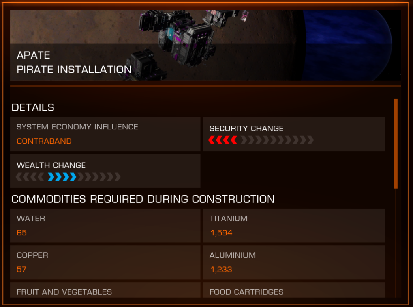
Security
Note: Anarchy-type factions follow entirely different mechanics; for them, the security slider is hard-locked in the center of the “none” slider. For all other government types, the following applies.
Security affects the overall security rating of the system, which in turn determines whether pirates or system security services will be interdicting you, and how quickly security forces respond in a non-anarchy system.
The security level of a system is not an absolute correlation to low/medium/high security for the system overall - it appears that as population grows (or some other variable grows) so does the required security score to maintain security “high.”
What security is also known to do is affect the “shape” of the security sliders for factions in a system, best shown in the composite image below:
Composite image of the faction state sliders of two different systems
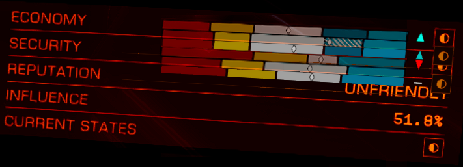
System statistics of the three systems compared above are as follows:
| Security | Tech Level | Wealth | Std. Of Lvg. | Dev. Level | |
|---|---|---|---|---|---|
| Top System | -3 | +7 | +8 | +5 | +9 |
| Middle System | +91 | +164 | +36 | +42 | +119 |
| Bottom System | +6 | +58 | +48 | +44 | +67 |
As you can see from the comparison above, the “none” section of the security slider for the higher-security system is roughly three times as wide as the one of the lower security system!
Finally, a low-security state for the systems will make an Interstellar Factor contact appear at the local stations.
Wealth
We do not really know what wealth affects in the system. It may affect the “economy” slider bar (much like system security does for the other bar), but, if it does, it is unclear exactly how.
We simply don’t know candidly.
Standard of Living
We do not really know how standard of living affects the system. It may affect the population growth formula, but, if it does, it is unclear exactly how.
We simply don’t know candidly.
Technology Level
Technology Level dictates, among other things, what services are “online” at ports in the system. There is a minimum technology level (35) for shipyards to come online at ports, noting that Tech Level 35 is immediately granted when a Tier 2 or 3 port is built23, so the requirement really only applies to Tier 1 Planetary Ports (as Tier 1 Space Outposts cannot have shipyards, period.)
Technology Level also appears to affect shipyard stock and modules available in outfitting at ports. Note that full shipyard availability is only possible at Anarchy(Independent)-Faction-controlled ports. Factions with other government types will have certain restrictions on what ships they sell.
We don’t know if Technology Level has other effects.
Development Level
Development level 0-20 affects the volume of available and demanded commodities in markets. It appears to “soft cap” at level 20.
“Initial” Population
“Initial” population appears to be amount of population added to the system when the facility is initially constructed.
Note that this value also depends on the local body where the facility is built (a Coriolis built around an Earth Like World or Water World appears to contribute a significantly higher population amount than, say, one built around an icy body.
We have precise formulae for population growth at this point, so this value isn’t of particular interest.
“Max” Population
“Max” population presumably affects the size of the overall “cap” affecting how high the population in a system can ultimately grow to become.
We have precise formulae for population growth at this point, so this value isn’t of particular interest.
Happiness
“Happiness” is a factor in the amount of credits you earn weekly for the systems you architected.
It is not directly influenced by facilities.
We do not know at this stage if “Happiness,” as it pertains to system architect payments, is the same concept or relates to “Happiness” of system factions.
We have reason to believe that system states do affect “Happiness” with positive ones raising it (such as Boom) and negative ones reducing it (such as Outbreak.)
We don’t know at this stage if other system statistics (Wealth, SoL, etc.) affect “Happiness” in any way.
Since the impact on overall gameplay of “Happiness” is truly minimal, this has not been a significant area of research for the community. Any serious study/input is welcome and we’ll gladly add it here!
What To Consider When Selecting A Primary Port?
Note that the location of the Primary Port in a given system is fixed and cannot be changed. It can be previewed by using the system map in architect mode and looking for the little “flag” icon inside an orbital slot designation.
The following factors should be taken into account when choosing what type of primary port to build:
- What is your intent for the system?
If you’re colonizing a system just to bridge to another place, you will most definitely want to build just a simple outpost; if you plan to “build up” the system instead you may want to consider T2 or even T3 alternatives, if the local body of the primary port is of interest.
Primary Ports in “bridge” systems should obviously be outposts.
- Will you be building the primary port solo or will a community be involved?
Building an outpost requires a minimum of 29 cutter-loads of hauling (and in practice several more) to complete. That number skyrockets to 267 when building an Orbis. Think carefully about how much time and effort you and others are willing to put into the build, also taking into account the 4-week time-limit of a primary-port build.
A solo player should almost24 always select an outpost as a primary port, unless they are highly determined and have set aside the necessary time and resources to build something bigger from the get-go.
- How far is the primary port from the drop-point in the system?
A primary port 20 Ls away from the A star will be accessible to build and will be easy to reach once built. A primary port 250,000 Ls parked at a moon of a planet orbiting the C star essentially forces you to build it relying on carriers, and will be a pain to reach in the future as well.
Primary Ports located at B, C, or further-out stars (and, in some rare cases, far-away planets at A stars) should almost25 always be an outpost.
- What is the local body associated with the primary port? How many planetary and orbital slots does it have?
If you intend to build up the system as a refinery, are willing to invest the time, and the primary port happens to be orbiting a 7-slot rocky planet right next to the A star, by all means go ahead and build a Coriolis (or even Orbis/Ocellus) as your primary port.
The number of orbital and planetary slots around/on the local body to which the primary port is attached also matters, as does the planetary vs orbital slot mix. If you want a true refinery powerhouse, you’ll want a number of refinery hubs below it.
Conversely if you want to build the most wretched hive of scum and villainy in the galaxy, you’ll want to build a Criminal Outpost in a spot with as many orbital slots available as possible - as that’s where you will be building pirate bases to form strong links with it.
Primary Ports orbiting local bodies with base inherent economies that match your plan for the system are good candidates for T2 (or even T3) Primary Ports. Conversely, if there is no match, specialized outposts are recommended.
What To Consider When Selecting A System To Architect?
The following factors should be taken into account when selecting a system to architect:
- What is your intent for the system?
Refineries rely on rocky planets. Industrial systems like icy bodies. Extraction centers want high metal content (or metal-rich) ones (bonus points if ringed) or a decent number of asteroid belts and ringed planets (to place asteroid bases). Tourism spots hinge on (whatever you want really, but presumably non-main-sequence stars and either Earth Like Worlds or Water Worlds.), etc.
Large planets (with more slots - up to 10 are possible, but more than 7 is very rare) are always preferable. A high number of space slots is always preferable.
“Tightly packed” planets/slots across a single main star are preferable (vs scattered planets across 5 separate and far-from-each-other stars.)
The characteristics of the system (number of slots, types of bodies) need to support your intent for said system.
- Where is the primary port in the system?
You will probably want to know that the primary port is 250,000 Ls from the drop point BEFORE you commit to building an Orbis there …
The primary port must be located in a slot you are willing to commit to build at.
- How far is the closest large-pad refinery?
Bringing hundreds of cutter-loads of metals over 1,000 LYs all the way from the bubble to the middle of nowhere is rather inconvenient. Make sure you appreciate where the closest refinery is to where you are building.
A large-pad refinery must be present within an acceptable (per your own definition) range of your target system.
- How far from the nearest inhabited system is your target?
Only systems within 15 LY of a populated system (excluding pre-populated systems outside of the bubble) can be directly claimed. Anything beyond that range requires bridging.
How many bridge outposts (if any) are you willing to build to reach your target system?
- Will the claim be competitive?
If you expect the claim to be competitive, you should plan accordingly (expect to “race” the last few days.)
Competitive claims require special considerations.
Which Economies Are Compatible With Each Other?
Special credit to CMDR nyatto who helped gather, study, and present this information, and to CMDRs Ian Doncaster and Ned Flandalorian who shed much light on the specifics of how this all works.
Economies in place #1 and #2 (Rank order being determined by their relative strength, and by -unknown-26 in the case of same-strength) for any given port have their supply “protected” from being netted out by demand from any other economy present at the port.
That means that a port with a e.g., refinery in its first or second economy strength will always supply e.g., steel, even if industrial and high tech economies are present at the same port (which would normally cut into or even entirely eliminate steel supply at such port).
This protection does not extend to the demand of such “top two economies”. The demand of the top two ports can and will be netted against the supply of any other non-top-two economy.
In summary:
- Supply for the top two economies “prevails”; if demand for commodities supplied by the top two economies is also present, it is simply disregarded (vs netted)
- Demand from the top two economies, and supply and demand both for all other economies, is netted out among all
As a result, the top two economies at each facility can “coexist” without cannibalizing each other’s demand and supply, and furthermore their supply will disregard consumption from economies in rank order 3+.
Such change lets CMDRs mix and match two of any economies without any negative repercussions.
But what if there are more than two economies? Take, for the example, the economies acquired by Colony-type ports built on these bodies:
-
On a High-Metal-Content or Metal-Rich Body
- Extraction inherently
- + Industry if geologicals are present
- + Terraforming & Agriculture if biologicals are present
- Note: Rings have no effect
- Extraction inherently
-
On a Jovian (e.g., Gas Giant) Body
- High Tech + Industrial inherently
- Note: Gas Giants cannot have geological or biological overrides
- + Extraction if a ring is present
- High Tech + Industrial inherently
-
On an Icy Body
- Industrial inherently
- + Extraction if geologicals or a ring are present
- + Terraforming & Agriculture if biologicals are present
- Industrial inherently
-
On a Rocky/Icy Body
- Industrial + Refinery inherently
- + Extraction if geologicals or a ring are present
- + Terraforming & Agriculture if biologicals are present
- Industrial + Refinery inherently
-
On an Ammonia World
- High Tech + Tourism inherently
- Note: AWs cannot have geological or biological overrides
- + Extraction if a ring is present
- High Tech + Tourism inherently
-
On a Water World
- Agriculture + Tourism inherently
- Note: WWs cannot have geological or biological overrides
- + Extraction if a ring is present
- Agriculture + Tourism inherently
-
On an Earth Like World
- Agriculture, HighTech, Military, Tourism inherently
- Note: ELWs cannot have geological or biological overrides
- + Extraction if a ring is present
- Agriculture, HighTech, Military, Tourism inherently
-
Orbiting a Star:
- Hitech + Tourism if a Black hole, Neutron Star, or White Dwarf
- Military in all other cases
A colony-type port built around a non-ringed Earth-Like World has 4 economies: Tourism (Primary - 1.4), HiTech (Secondary - 1.4), Agriculture (1.4) and Military (1.0); a ring would throw Extraction in the mix too
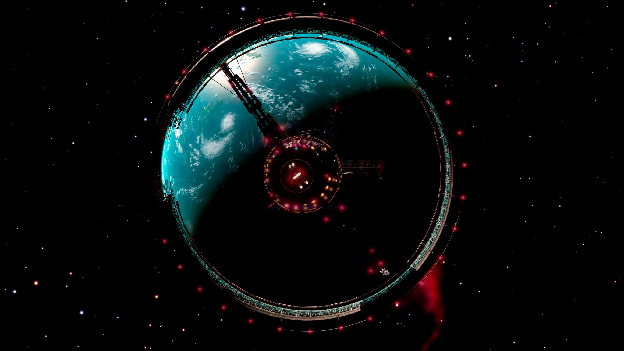
Since icy bodies, rocky bodies, gas giants and high metal content bodies make up the bulks of bodies in the galaxy, and since geologicals, biologicals, and rings are fairly common … many colony-type ports built by CMDRs will start with 3 or more intrinsic economies.
Here’s a set of tables of what economies “tolerate” (or even boost!) other economies in 3rd place or lower. Note that the order matters: 1st and 2nd place economies always tolerate each other, regardless of type. The question is really - how will economies in 3rd place and below, interact with all the others present (including the top two)?
[To be confirmed] The rank-order of same-strength economies is purely alphabetical and, as such, it goes Agri->Ext->HiTech->Ind->Mil->Ref->Serv->Terraf->Tour.
Summary table of compatibilities; for details, see Appendix D:
| Agri | Ext | Ref | Ind | HiTech | Tour | Mil | Terraf | Serv | |
|---|---|---|---|---|---|---|---|---|---|
| Agri | |||||||||
| Ext | |||||||||
| Ref | |||||||||
| Ind | |||||||||
| HiTech | |||||||||
| Tour | |||||||||
| Mil | |||||||||
| Terraf | |||||||||
| Serv |
Legend [as best assessed by guide authors - details in appendix to form your own opinion]:
- Green is highly compatible (significant boosted overlap, minimal cannibalization)
- Yellow is compatible (some or minimal boosted overlap, little cannibalization)
- Orange is somewhat incompatible (some cannibalization)
- Red is incompatible (significant cannibalization)
A detailed spreadsheet compiled by CMDR nyatto and CMDR Corvegan on what economies consume and produce is available here. Below is a simplified version of the spreadsheet formatted to fit in this document.
| Commodity / Category | Agri | HiTech | Ind | Ref | Ext | Mil | Serv | Tour | Terra | |||||||||
|---|---|---|---|---|---|---|---|---|---|---|---|---|---|---|---|---|---|---|
| Chemicals | ||||||||||||||||||
| Liquid oxygen | C | P | ||||||||||||||||
| Pesticides | C | P | ||||||||||||||||
| Surface Stabilisers | 🌍C | 🌍C | 🌍C | P | 🌍C | 🌍C | 🌍C | 🌍C | ||||||||||
| Water | P | C | C | C | 🌍P | 🛰️C | C | C | C | |||||||||
| Consumer Items | ||||||||||||||||||
| Evacuation Shelter | 🌍C | P | 🌍C | 🌍C | 🌍C | 🌍C | 🌍C | 🌍C | ||||||||||
| Survival Equipment | 🌍C | 🌍C | P | 🌍C | 🌍C | 🌍C | 🌍C | 🌍C | ||||||||||
| Legal Drugs | ||||||||||||||||||
| Beer | P | C | C | C | C | C | P | C | C | |||||||||
| Liquor | P | C | P | C | C | C | P | C | C | |||||||||
| Wine | P | C | C | C | C | C | P | C | C | |||||||||
| Foods | ||||||||||||||||||
| Animal Meat | P | C | C | C | C | C | C | C | ||||||||||
| Coffee | P | C | C | C | C | C | C | C | ||||||||||
| Fish | P | C | C | C | C | C | C | C | ||||||||||
| Food Cartridges | C | P | C | C | C | C | C | |||||||||||
| Fruit and Vegetables | P | C | C | C | C | C | C | C | C | |||||||||
| Grain | P | C | C | C | C | C | C | C | ||||||||||
| Tea | P | C | C | C | C | C | C | C | ||||||||||
| Industrial Materials | ||||||||||||||||||
| Ceramic Composites | C | C | 🌍P | |||||||||||||||
| CMM Composite | C | C | 🌍P | C | ||||||||||||||
| Insulating Membrane | C | C | 🛰️P | C | ||||||||||||||
| Polymers | C | P | C | C | ||||||||||||||
| Semiconductors | C | P | C | |||||||||||||||
| Superconductors | C | C | P | C | ||||||||||||||
| Machinery | ||||||||||||||||||
| Building Fabricators | 🌍C | P | 🌍C | 🌍C | 🌍C | |||||||||||||
| Crop Harvesters | C | P | ||||||||||||||||
| Emergency Power Cells | C | 🌍P | C | |||||||||||||||
| Geological Equipment | 🌍C | P | 🌍C | 🌍C | ||||||||||||||
| Microbial Furnaces | P | C | ||||||||||||||||
| Mineral Extractors | P | C | ||||||||||||||||
| Power Generators | C | C | P | C | C | C | C | C | ||||||||||
| Thermal Cooling Units | 🌍C | P | 🌍C | 🌍C | 🌍C | |||||||||||||
| Water Purifiers | C | C | P | C | C | C | C | C | ||||||||||
| Medicines | ||||||||||||||||||
| Agri-Medicines | C | P | ||||||||||||||||
| Basic Medicines | C | P | P | C | C | C | C | C | ||||||||||
| Combat Stabilisers | C* | P* | C* | C* | C* | C* | C* | C* | ||||||||||
| Metals | ||||||||||||||||||
| Aluminium | C | P | C | |||||||||||||||
| Copper | C | P | ||||||||||||||||
| Steel | C | P | C | |||||||||||||||
| Titanium | C | P | C | |||||||||||||||
| Technology | ||||||||||||||||||
| Advanced Catalysers | P | C | ||||||||||||||||
| Bioreducing Lichen | P | C | ||||||||||||||||
| Computer Components | C | P | C | |||||||||||||||
| H.E. Suits | P | C | C | C | C | |||||||||||||
| Land Enrichment Systems | C | P | C | |||||||||||||||
| Medical Diagnostic Equipment | P | C* | ||||||||||||||||
| Micro Controllers | P | C | C | |||||||||||||||
| Muon Imager | 🌍P | 🌍P | 🌍C | 🌍C | ||||||||||||||
| Resonating Separators | P | C | ||||||||||||||||
| Robotics | P | C | ||||||||||||||||
| Structural Regulators | 🌍C | P | 🌍C | 🌍C | 🌍C | 🌍C | 🌍C | 🌍C | ||||||||||
| Textiles | ||||||||||||||||||
| Military Grade Fabrics | P | |||||||||||||||||
| Waste | ||||||||||||||||||
| Biowaste | C | P | P | P | P | P | P | P | P | |||||||||
| Weapons | ||||||||||||||||||
| Battle Weapons | C* | P* | P* | C* | P* | P* | ||||||||||||
| Non-Lethal Weapons | C | P | C | C | C | P | C | C | ||||||||||
| Reactive Armour | C | P | C | C | C | P | C | C |
* Special conditions apply, consult the Notes column on the original spreadsheet.
What Does Population Affect, And How Do I Grow It?
Note: This section has been entirely re-written in v2.3.0 and is now believed to be correct and reliable. However, we are missing a lot of data for a number of local body types. We will add more as we receive and validate it.
Special credit to CMDR Betel01 for this section; without his outstanding data, it would never have been possible to reverse-engineer these formulae.
Tier 3 ports at Earth-Like Worlds will eventually grow population to 3.1 billion
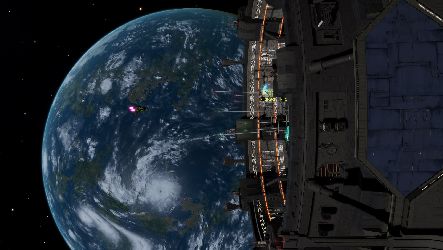
Regarding population growth, FDEV’s official patch notes say: Populations [sic] will grow on each weekly maintenance tick. Populations [sic] growth is based on a curve and will grow quickly for the first month before slowing to a more gradual pace, enabling quick establishment of strong economies.
Regarding the effect of population on facilities in a given system, FDEV’s official patch notes say: The overall level of facility output is determined by the population associated with that facility - a higher population results in greater output of commodities.
Facilities attract population based on the type and tier of the facility, and based on the nature of the Local Body they are placed either on or in orbit of.
Population growth follows a hybrid formula, being a set value for the first 14 “ticks27”, and then following a logistic formula thereafter - which eventually saturates towards an asyntotic value (after about a year.)
Production grows with the square root of population, resulting in the following patterns:
Population and supply/demand growth for a Tier3 orbiting an ELW
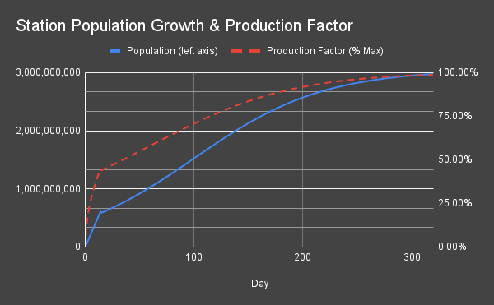
The exact population growth formula for a space port28 is as follows:
Exact Population Hybrid growth formula; K varies: it is 3.05 billion for an ELW and Tier 3 port
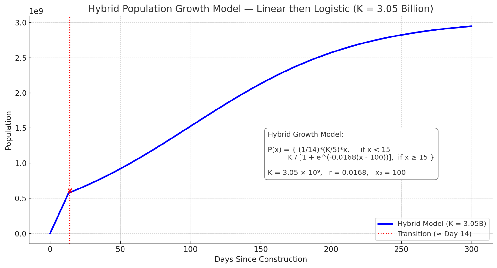
What the formula and our studies so far tell us:
- A station will grow quickly to 20% of its max population and 44.72% of its max population-driven production in 15-16 days (14 full ticks)
- A station will take about a full year to approach its max asymptotic population (“K”) and production
- The population-driven production of a Coriolis is 18.11% that of an Orbis. I.e., a T3 Orbis will demand and supply over 5 times the commodities of a T2 Coriolis, other factors being equal.
- Tier 1 Planetary Ports are quite powerful in terms of population, and associated supply and demand - at a K population of 48m they vastly outclass even Tier 2 Coriolis Starports in terms of population.
Each local body has a population modifier which applies to [need more research on which ports it specifically applies to versus not - at the very least it applies to the main spaceport in orbit and to the largest planetary port on the surface.]
| Body | Space Station Tier 3 | Mapping value | Rapid Build (C+15) pop | Inflection (C+120/10029) pop | Asintotic Pop (“K”) (~C>365) | Body Pop Multiplier (vs MSS) |
|---|---|---|---|---|---|---|
| Earth-Like World | Tier 3 - Orbital | 957,230 | 610m | 1,525m | 3,100m | TBD |
| Earth-Like World | Tier 2 - Orbital | 20m | 50m | 100m | TBD | |
| Earth-Like World | Tier 1 - Orbital | TBD | TBD | TBD | TBD | |
| Water World | Tier 3 - Orbital | 365m | 912.5m | 1,825m | TBD | |
| Water World | Tier 2 - Orbital | TBD | TBD | TBD | TBD | |
| Water World | Tier 1 - Orbital | TBD | TBD | TBD | TBD | |
| Main Sequence Star | Tier 3 - Orbital | TBD | TBD | TBD | TBD | |
| Main Sequence Star | Tier 2 - Orbital | TBD | TBD | TBD | TBD | |
| Main Sequence Star | Tier 1 - Orb. (Crim.) | 4,581 | 1.96k | 27.37k | 136.85k | 1.0x |
| HMC World | Tier 1 - Planetary | 9.6m | 24m | 48m | TBD | |
| Icy Body | Tier 1 - Orb. (Comm.) | 2,221 | 5.43k | 76.02k | 380.01k | TBD |
Population has a number of effects:
- Population increases production of the applicable facility only. Having a billion system population does nothing to affect production on a single-facility icy body.
- Supply and Demand increase with the square root of population
- Population increase the grade of emissions (e.g., High Grade Emissions vs Low Grade) spawning
- Population makes swinging BGS control of the system require more effort
- … it does also come with bragging rights.
[BUG? To be verified] Note: There are anecdotal reports that demolishing facilities does NOT reduce system population accordingly.
System Score And Credits Per Week
Special credit to CMDRs DaftMav and Grinning2001 who assembled most of the data for this section.
Every system has a “score” which takes into account which facilities have been built in said system. Population is not a factor in a system’s score. See Appendix C: Detailed By-Facility System Scores for detailed values by facility.
The score of the system directly feeds into the credit payments which the system architect receives on a weekly basis. Positive happiness will adjust it higher, and vice-versa for negative happiness. Note that we presently know very little about what affects happiness, but its effect is truly minor as it rarely varies more than plus or minus 20%.
The formula is as follows:
Credits Per Week30 = System Score * ~10,00031 Credits * (1 + Happiness)
Colonization pays very little credits, considering the effort involved. A highly-built 100-point system will pay a meager 1 million credits per week. For reference, compare that to a kitted carrier operating cost of 30 million per week.
Colonization may be pretty, but it does not pay well
How To Haul Effectively And Make Best Use Of Carriers?
Optimizing Hauling
The best haulers in the game are:
- The Panther Clipper Mk2
- The Imperial Cutter for those with the Imperial rank of Duke (or higher)
- The Type 9 for those without said Imperial rank
See “getting started” section in this document for suggested build links.
Unless you plan on flying manually all the time, your hauler will likely greatly benefit from having supercruise assist and an advanced docking computer. The supercruise assist module can also be used to “hyperbrake32” at orbital sites.
Having a friend wing with you and AFK at your destination can also speed things up significantly - as dropping using wingman navlock is significantly faster than even hyperbraking with supercruise assist.
Using bookmarks speeds up use of the galaxy and system map for navigation, and using hotkeys for galaxy and system map speeds up accessing those menus.
Where possible, using trailblazer megaships to stock up is ideal - as they are very quick to reach and dock at, and stock most materials required for colonization (including materials which are otherwise planetary-only, and thus much slower to acquire). Carrier parking spots may be limited around them however.
Depending on where you’re building, you may be better off doing short trips loading and unloading your carrier (if you have one), rather than doing direct hauls from source to destination.
An Imperial Cutter On Its Way To Deliver A Load Of Metals To A Planetary Construction Site
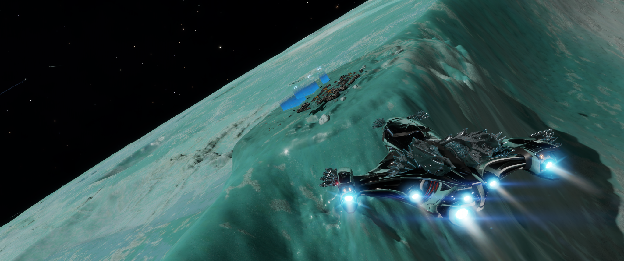
Optimizing Carriers
Carriers are incredibly useful considering the enormous amount of hauling that colonization requires and the vast distances that often need to be covered to bring resources to where they are needed.
The best use of carriers is to strip down the carrier to have only the following truly essential modules: Rearm, Refuel, Repair. This way you will achieve a maximum of 24,070 cargo capacity (aka metahauling).
The general principle is to use your ships to do short, quick hauls from the supplying station to the carrier, and use the carrier to do big moves of resources, and then to transfer from the carrier to the colonisation ship (or site) at the other end.
Transferring cargo at carriers is frustratingly slow when using the transfer screen in your right panel. You are much better off placing a market sell order (to yourself) for the resources you want to deliver and “buy them” from the carrier market (be careful what price you set if your carrier is open for all to dock at!)
Carriers also allow to set market orders so that other players can earn credits while e.g., loading up your carrier while you sleep. This can quickly get expensive, as the going rate to short-haul 1t of cargo is in the 30,000-60,000cr range. Even at just 30k per ton, it’ll cost you ~720m credits to have other players fill up a 24,000ton carrierload. If you’re going this route, make sure to connect your CMDR’s account to Inara and/or post orders on the trade bulletin of the Fleet Carriers Owners Club and/or PTN discords - those are two primary ways CMDRs who want to haul for credits find orders to fill. Note that you will still have to unload your carrier yourself. Services that aim to help with that as well do exist, but they are comparatively immature and quite clunky at this time.
A Victory-Class Fleet Carrier Arriving Into A System, Ready To Unload Commodities For Colonization
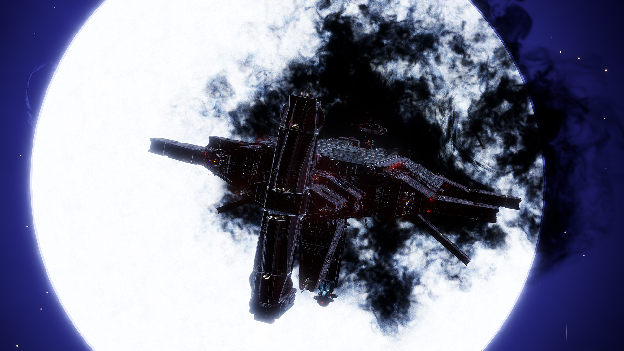
“Contractors” And Community Support
Various communities offer their services either for free or on a contract basis to support players with their colonization efforts. These include, but are not limited to:
- System Colonization Contractors (SCCN)
- F.R.E.I.G.H.T. (FRHT)
- Operation Ida (OIDA)
- Colonizers Trade Network (CTN)
Case Study #1: Building An “Ideal” Refinery System
If building a refinery, you will generally want a ground port (for CMMs et al.) plus space port (for Insulating Membranes et al.) pair. The below takes this dual-port design into account.
In increasing order of preference:
Gas Giants, Ammonia Worlds, Earth-Like-Worlds, Water Worlds, Asteroid Belts, Stars of all kinds
- These can only become refineries through weak links; and that’s beyond the point of this guide.
- Note: Refinery cannot be “tucked under” a Tier3 in space at ELW, WW, AW or similar.
Icy Bodies
Vanilla: Manageable, starts with Industry only
- Geologicals and/or Ring: Manageable (Add +Ext)
- Biologicals: Bad (Adds [a very weak] +Agri, +Trfrm)
- (Geo or Ring) AND Bio: Bad (Adds +Agri, +Trfrm, +Ext)
Recommended type of planetary and space port: Specialized on the ground if not “vanilla” (else Colony can work, too). Specialized for T1 in space, or Colony-type for T2+.
Icy Bodies can support strong refinery economies if they come with a good number of planetary slots (at least 3, 5 being good, 7 being great). They generally rely on using “specialized” (industrial or scientific) T1 ports on the ground, unless it is “vanilla”, then Colony-type works too.
Pros: Most common of all planets
Cons: While it can be made to work, there are usually better options for a refinery
High Metal Content World
Vanilla: Manageable, starts with Extraction only
- Geologicals: Manageable (Add +Ind)
- Biologicals: Bad (Adds +Agri, +Trfrm)
- Geo AND Bio: Bad (Adds +Agri, +Trfrm, +Ind)
- [Note: Rings are irrelevant for economy in HMCs, as HMCs already all have extraction]
Recommended type of planetary and space port: Always specialized on the ground. Specialized for T1 in space, or Colony-type for T2+ (unless ring available, then Asteroid Base is a better T2 option in most cases!).
HMCs can support strong refinery economies if they come with a good number of planetary slots (at least 3, 5 being good, 7 being great). They rely on using “specialized” (industrial or scientific) T1 ports on the ground - always industrial if geo is also present; choice among the two if not.
Pros: Very common, often has many ground slots
Cons: Need to go the “specialized” port route
Rocky World
Vanilla: Great, starts with Refinery only
- Ring: Good (Adds +Extraction)
- Geologicals (or also Geo + Ring): Manageable (Add +Ind, +Ext)
- Biologicals: Manageable (Adds +Agri, +Trfrm)
- Geo AND Bio (with or without rings): Bad (Adds +Agri, +Trfrm, +Ind AND +Ext)
Recommended type of planetary and space port: Colony-type if not geo AND bio present, specialized otherwise
Rocky Worlds make for the best “pure refineries” (if vanilla), or good ref+ind+ext “combo” economies (with geological and/or rings), so long as they have NO organics. They also work as possibly the best combined Ref+Agri setups if bio are present. Like rocky+icy, you don’t really want to have both geo AND bio present tho.
Pros: Relatively common, great basis for refineries
Cons: They generally have limited construction slots
Rocky Ice World
Vanilla: Best, starts with Refinery and Industry
- Geologicals, Ring, or Geo + Ring: Manageable (Adds +Ext)
- Biologicals: Manageable (Adds +Agri, +Trfrm)
- Geo AND Bio (with or without rings): Bad (Adds +Agri, +Trfrm AND +Ext)
Recommended type of planetary and space port: Colony-type if not geo AND bio present, specialized otherwise
Rocky Ice Worlds make for the best refinery+industrial “combo” economies, so long as they have NO organics. They can tolerate geologicals and rings, at the “price” of weaker industrial economies.They can also tolerate biologicals. The only “bad” combinations (for a refinery) is BOTH geo AND bio, or bio and a ring.
Pros: Possibly the best planet in the game for colonization materials production
Cons: They are rare, and generally have limited construction slots
Rocky-Icy Bodies make for some of the finest refineries in the game

Case Study #2: Building An “Ideal” Agriculture System
Space Farms are very green!
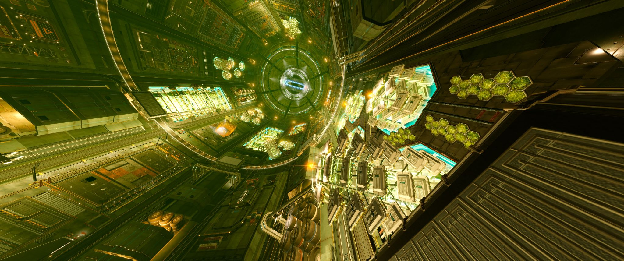
Unlike refineries, for Agriculture ports you will generally EITHER use a ground port OR go with a space port, as either one will produce everything you may want in terms of agricultural products. Note that occasionally planetary (but NOT orbital) agricultural ports can get bugged and produce no agricultural goods at all - for that reason, you may want to prefer orbital agriculture ports for the time being.
Note that "tidally locked”, which is a fairly common modifier, will majorly interfere with ALL agricultural builds, making icy bodies even more useless, and crippling many of the others too. The comments below assume that the body is NOT tidally locked.
In increasing order of preference:
Gas Giants, Ammonia Worlds, Asteroid Belts, Stars of all kinds
- These can only become agricultural through weak links or by building space farms next to them (and space slots are usually more limited than planetary ones)
Icy Bodies & Rocky Ice Worlds
Vanilla: Poor, starts with Industry (or Ind+Red) only, but with a malus to agricultural strong links
- Geologicals and/or Ring: Bad (Add +Ext)
- Biologicals: Poor (Adds [a very weak] +Agri, +Trfrm)
- (Geo or Ring) AND Bio: Terrible (Adds +Agri, +Trfrm, +Ext)
Recommended type of planetary and space port: N/A - Don’t build farms on icy bodies
Icy Bodies can rarely have inherent agriculture economies (with organics) but their malus to agricultural strong links means they make for really poor farms.
Pros: Will feed you if you’re starving and have nothing else to eat
Cons: There are significantly better choices for farms
Earth-Like Worlds
Vanilla: Good, starts with Tourism, Hitech, Agriculture, Military
- Ring: Manageable (Adds +Extraction)
- Note: ELW and WW cannot have biological or geologicals
Recommended type of space port: Colony-type always
ELWs, counter-intuitively, make only middling farms because they have so many economies and so few ways to specialize those economies. If you have 2-3 space slots, coupling a Tier 3 station with a ELW (which gets a MASSIVE population and thus production boost to Agriculture), and 1 or 2 (as many as slots allow) space farms, CAN WORK, but it won’t work nearly as well as HMCs, RWs, or WWs.
Pros: They look great; Massive population boost; “Status Symbol” of Colonization
Cons: Very Rare; Cannot have ground facilities nor organics boost; Make only middling farms.
High Metal Content World
Vanilla: Pretty good, starts with Extraction only
- Geologicals: Manageable (Add +Ind)
- Biologicals: Good (Adds +Agri, +Trfrm)
- Geo AND Bio: Manageable (Adds +Agri, +Trfrm, +Ind)
- [Note: Rings are irrelevant for economy in HMCs, as HMCs already all have extraction]
Recommended type of planetary and space port: Colony-type if organics are present; personal choice of any type if not, for both Planetary and Space Ports.
HMCs can support some of the best agriculture economies if they come with a good number of planetary slots (at least 3, 5 being good, 7 being great) and space slots. Organics are good here, though not essential - most of your economy value should come from installations and the strong links they provide.
Pros: Very common, often has many ground and space slots
Cons: Extraction economy is often seen as a “low value pair” to Agriculture
Rocky World
Vanilla: Great, starts with Refinery only
- Ring: Manageable (Adds +Extraction)
- Geologicals (or also Geo + Ring): Not Great (Add +Ind, +Ext)
- Biologicals: Absolute Best (Adds +Agri, +Trfrm)
- Geo AND Bio (with or without rings): Bad (Adds +Agri, +Trfrm, +Ind AND +Ext)
Recommended type of planetary and space port: Colony-type if not geo present, specialized otherwise
Rocky Worlds, either vanilla or with organics, are possibly the best choice for farms, owing to the great combination that refinery+agriculture is, and due to the fact that you can operate with just two (Ref+Agri, if vanilla) or three (Ref+Agri+Trfm, if biologicals present) economies.
Pros: Relatively common, best farms you can make outside of water worlds
Cons: They generally have limited construction slots
Water Worlds
Vanilla: Excellent, starts with Tourism, Agriculture
- Ring: Manageable (Adds +Extraction)
- Note: ELW and WW cannot have biological or geologicals
Recommended type of space port: Colony-type always
Water Worlds make for better farming worlds than ELWs, because ironically they have fewer economies. Especially if you have 2-3 slots, coupling a Tier 3 station with a water world (which gets a MASSIVE population and thus production boost to Agriculture), and possibly 1 or 2 (as many as slots allow) space farms, will easily make the best space farms in the game.
Pros: Best space farms in the game
Cons: Rare; Cannot have ground facilities nor organics boost
A Tier-3 Port above a non-tidally-locked Water World hits 450m Population, with a fantastic Agricultural economy
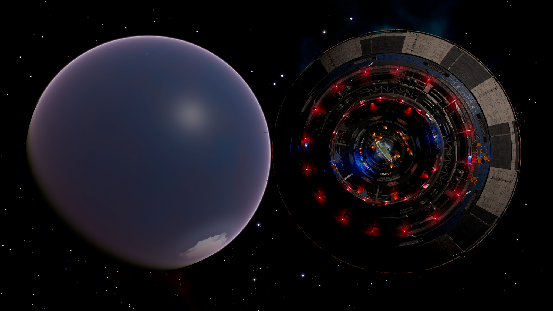
Frequently Asked Questions
Q: I forgot what I built in System XYZ; how can I find out what the exact facility type is?
Hit “demolish” in the facility view (don’t worry, it’ll ask for confirmation and, even then, it just flags it for weekly demolition, which you can cancel at any time) - the demolition view is the only place in the game where the exact facility type is listed.
Q: What makes for a “good” system? Should I claim System XYZ?
Well, what do you want to do with it? Every system can be a “good” system in a sandbox game and have its perfect purpose, based on your imagination. That being said, systems without any ground slots will greatly limit your options. Try to look for systems that have at least 10 ground and 10 space slots. Fewer than that, and you’ll really have to heavily specialize in particular niches.
Q: My refinery is not making CMM Composites (or Insulating Membranes). Why?
Only orbital refineries make Insulating Membranes. Only planetary refineries make CMM (and Ceramic) Composites. To get a full complement of refinery goods, you’ll need both an Orbital and a Planetary refinery. For a detailed list of which goods are exclusive to Orbital vs Planetary for each industry type, refer to the relevant section in this guide.
Q: How can I make Battle Weapons, Combat Stabilizers, and/or Emergency Power Cells?
For Battle Weapons, you’ll want a HiTech, Industrial, or Military economy in a port controlled by either a Communist, Dictatorship, or Anarchy faction. For Combat Stabilizers, you’ll specifically need a HiTech port controlled by an Anarchy or Dictatorship faction. Emergency Power Cells are only produced by High Tech and Refinery systems within 30 ly of the Akhenaten system and by player-created GROUND industrial settlements.
Q: If I build more than one port in orbit of a WW or ELW, will each port benefit from the population boost such bodies provide?
[To Verify] At this time, reports indicate that only the first-built among the highest-tier ports present around a given body benefits from the population boost. Ports which convert to supporting facilities do not.
Q: What is the maximum theoretical population for a player-colonized system?
The maximum number of ELWs in a single system found across the galaxy is 4, in a smattering of systems (Topaz, Phekda, G 123-49, Gandharvi, Sol, and 12 others … not all of which are even colonizable).
Assuming you’d be able to place a Tier 3 port around each, and wait about a year for each to reach its 3.1b population potential, the maximum theoretical population for a system is thus approximately 12.4b. Systems above 5bn, however, will in practice be very rare. Systems above 2bn won’t be unicorns but will still be rare (as 1.8b is the max for a WW, and WWs are a lot more common than ELWs.)
While it is possible for systems without AWs, WWs or ELWs to reach over a billion in population (primarily by spamming T3 and T1 planetary ports), the above is a very unconventional strategy, and is unlikely to see much use in practice.
Q: My XYZ port is controlled by a faction I deeply despise. How do I have my preferred faction take it over? Furthermore, how can I influence which factions control what?
You’ll have to trigger a BGS war. This is a lengthy (read: weeks) and very complicated process which is beyond the scope of this guide. If you care to learn more, see this excellent BGS guide. The initial factions in a system are determined according to set rules; see relevant section in this document. Subsequent facilities are allocated at random to the different factions in the system; there’s nothing you can do about this sadly.
Q: How can I get my port to spawn passenger missions?
Passenger missions will spawn after a station is onlined after weekly downtime post being built. There are reports however of certain stations never acquiring passenger missions. More research is ongoing.
Q: How can I get a material trader or tech broker to spawn at my port?
At this time, it is not possible to have material traders at player colonies. Sorry!
In order to have access to a human tech broker, you need to build a “Dodec” Tier 3 station.
Guardian & Sirius Tech brokers are not presently available to player-colonies.
Q: How do I get an Interstellar Factor (and its mercenary counterpart) to spawn at my station?
Interstellar Factors only spawn at systems in low security. Note that while they spawn immediately when security drops to such level, the displayed security value in the system may take up to the weekly Thursday server maintenance to update - so while it may appear that IFs show up at greater-than-low-security systems, chances are that the system security state has dropped but hasn’t visually been updated yet.
[Will expand in future document revisions]
Bugs, Known Issues, And Possible Workarounds
Colonization is still in Beta; multiple issues still exist. Some have workarounds and some don’t.
We tried to capture a list here. This is likely incomplete, but hopefully will serve as a reference for players.
| Issue Name | Issue Tracker Link | Issue Description | Workaround |
|---|---|---|---|
| Orbital Station Moves Away at High Speed - Unable to Dock | https://issues.frontierstore.net/issue-detail/75280 | Under certain conditions the frame of reference for orbital construction sites is incorrect, and such sites become impossible to reach | Avoid building around closely-orbiting moons and/or binary bodies in close proximity to each other and/or large stars and non-main-sequence-stars |
| List of commanders who completed station missing. | https://issues.frontierstore.net/issue-detail/74618 | CMDR’s contribution isn’t correctly reported in ports bulletin board | Learn to live with a bruised ego for the time being |
| "You are in danger" quitting delay shown when landed on construction site | https://issues.frontierstore.net/issue-detail/73254 | Logging off at construction sites triggers the 15-second “in danger” countdown timer | Wait out the timer, or log out elsewhere |
| Terraformorable modifier for agriculture not working | TBD | Planets which are “Candidates for Terraforming” should boost agriculture - but they presently don’t | Take the missing modifier into consideration when building |
| Agriculture Planetary ports bug out / produce no agri goods | TBD | Occasionally planetary (but not orbital) ports can “bug out” and produce no agricultural commodities at all | Focus on orbital agricultural facilities for the time being |
| Vista Genomics and Pioneer Supplies are always available | TBD | Requirements for Vista Genomics and Pioneer supply to “activate” in certain facilities do NOT apply - they are always active. | Just be aware that one day the requirements may be fixed. |
How To Provide Feedback
Colonization in Elite: Dangerous is an incredibly complex topic, as the existence of this somewhat-incomplete 100+ page document proves.
To provide input on this document, you’re welcome to do so in any of these channels:
- On CMDR Mechan’s YouTube channel, through comments on the announcement video of this document
- On the Reddit post announcing this document
- On the Frontier Forums thread announcing this document
- In the Anti-Xeno Initiative Discord server, in channel [#colonize-goids-away] in the “Operations” section.
Tourism economies aren’t all that useful, but they sure look pretty!
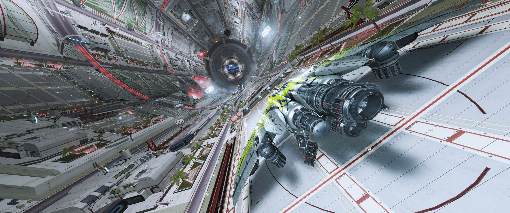
Appendix A: Advanced Strategies
Note: This section is meant for advanced system architects who have several built systems “under their belts” and thus have a pretty good understanding of the mechanics of colonisation. If you are architecting your first system, we do NOT recommend pursuing these strategies, as chances are you’ll get something wrong, and mistakes in facility construction are “expensive” in terms of wasted time and effort.
“Flipping” economy order
It is sometimes more important to flip the order of economies, than to boost particular economies. The most common example is wanting to build a refinery on a HMC which also has geologicals - such planet will have Extraction + Industry + (if you build a refinery hub) Refinery. What is more important here however is to move extraction to be in 3rd place behind Ref and Ind - as Ref+Ext and Ind+Ext are compatible, but Ind+Ref is NOT. So rather than just plotting down Refinery hubs, you’ll want a couple of industry hubs too!
Once you get Refinery and Industrial in top two places, the now-third-place extraction economy won’t really interfere with either, and you’ll have your nice Refinery+Industrial complex working as intended.
Farming Tier 3 CPs, then deconstructing and replacing
As it is now possible to “go into the negative” with regards to construction points, one can “farm” Tier 3 CPs using Tier 2 large ground facilities (which uniquely convert ONE T2 CP into TWO T3 CP points) and, once the desired number of Tier 3 ports has been built in a system, proceed to deconstruct said ground facilities and replace them with others possibly more beneficial to the target system design (such as hubs, ports, etc.). You can also use these to build enough T2 points to build an additional Coriolis which you otherwise would not have been able to squeeze into the system plan.
Be sure you are done with Tier 3 construction when attempting this however, as you would have to “dig yourself out of the negative T3 CP hole” first should you ever want to build more.
“Sheltering” a lower-tier port beneath a higher-tier one
Building multiple ports around a local body results in lower-tier ones converting to supporting facilities. In addition to resulting in them forming a strong link with the parent facility, this has the unique effect of preventing said ports from receiving any incoming strong links from the local body also.
The cases where you may want to do so are pretty niche (you really must want two or more ports with different economies around a given body …) but it is possible and an arrow in your quiver should you desire to.
“Dumping” Tech Level system stat
Tier 2 and Tier 3 ports automatically grant Tech Level 35 at them and system-wide upon construction.
As a result, unless you plan for a high-tech-system with a Tech Level well above 35, there really isn’t any reason to invest in tech facilities just to boost the tech level of a Coriolis (or better) starport.
You may be better-served by building facilities that cater to other aspects of the system and “dump” the Tech Level stat, as your Coriolis (or better) will give you a solid TL35 by itself.
Build Tier3s first (and before T2 ports)
Note: Only really applicable to “Capital” systems (systems you or, more often, a group of players want to build up to very significant levels.) If you plan to only build up to Tier2 ports in your system, you can ignore this section entirely.
Building a Tier3 starport as the primary port is no small undertaking. But it will give you a “free” (slots-wise) Tier3 station (one that doesn’t require supporting infrastructure to be built nor does it impact the CP cost of future stations). So long as the primary port slot is at least somewhat desirable in a “Capital” system, a group should start the build with a T3 primary port for the reasons above. You effectively get to cram one extra T3 station (than otherwise would be possible based on slots available) in a system by doing it.
Following your primary port build, you want to build all your intended Tier3 ports ahead of any Tier2 ports you eventually plan to build. The reason for doing so is that the points cost for Tier3s goes 6->12->18… while the points cost for Tier2s only goes 3->5->7… as a result, the build order matters immensely. Late-built Tier3s are exceptionally more expensive compared to late-built Tier2s. Save your Coriolis and Asteroid Bases for last in your build plan.
“Nesting” ports to create industry or refinery strong links without ground slots
You’d imagine that building strong links in space for industry and refinery isn’t possible … except that it is - you just need to convert spaceports (typically Tier 1s) into supporting facilities to do it.
Example: Build a commercial outpost in orbit of a gas giant. Outpost becomes hitech+industry. Then build a Coriolis around the same gas giant. Lower tier port converts to supporting facility and provides the coriolis with both hitech AND industry strong links, without the need for ground slots. The same can be done with a rocky body with no planetary slots for a refinery.
“Nesting” ports to spawn specific types of missions
Certain missions, such as, for instance, source-and-return and mining rush missions, spawn at stations only when certain criteria are met. Some such criteria require a station to NOT have certain economies present, which may be harder in a larger system with a lot of weak links.
Nesting a same-tier or lower-tier port in the same local body ensures that one converts to a supporting facility and is “protected” from incoming weak links. Doing so at a “vanilla” HMC/Rocky/Icy body creates supporting facilities which are, respectively, pure extraction, pure refinery, or pure industry.
This strategy is most commonly used to spawn mining rush missions (at pure industry.) Bonus points for coupling two large-pad stations such as Coriolis … that way you can e.g., go buy extraction materials and return to fill missions real fast!
Appendix B: Links And Resources
Patch notes (primary source for this document, together with forum posts and original research):
- https://www.elitedangerous.com/update-notes
- Note: 3.3 patch notes on website are out of date; latest are in forum post here: https://forums.frontier.co.uk/threads/elite-dangerous-trailblazers-update-3-3.638196/.
Colonization System Planning Tools:
- CMDR Grinning2001’s Raven Colonial: https://ravencolonial.com/#home
- CMDR DaftMav’s Spreadsheet: DaftMav’s Colonization Construction Spreadsheet
- Ian Doncaster’s Hybrid Market Planner: https://cdb.sotl.org.uk/specialisation/hybrid
Colonization Bridge Design:
Carrier / Hauling / Contracting communities:
- System Colonization Contractors (SCCN)
- Operation Ida (OIDA)
- F.R.E.I.G.H.T. (FRHT)
- Colonizers Trade Network (CTN)
Appendix C: Detailed By-Facility System Scores
Coriolis Starport : 8
Asteroid Starport : 8
Ocellus Starport : 15
Orbis Starport : 15
Commercial Outpost : 3
Industrial Outpost : 3
Pirate Outpost : 3
Civilian Outpost : 3
Scientific Outpost : 3
Military Outpost : 3
Satellite Installation : 3
Communication Installation : 3
Space Farm : 2
Pirate Base Installation : 3
Mining/Industrial Installation : 2
Relay Installation : 3
Military Installation : 4
Security Installation : 3
Government Installation : 3
Medical Installation : 4
Research Installation : 4
Tourist Installation : 3
Space Bar Installation : 4
Civilian Surface Outpost : 4
Industrial Surface Outpost : 4
Scientific Surface Outpost : 4
Large Planetary Port : 15
Agriculture Settlement: Small : 1
Agriculture Settlement: Medium : 2
Agriculture Settlement: Large : 4
Mining Settlement: Small : 1
Mining Settlement: Medium : 2
Mining Settlement: Large : 4
Industrial Settlement: Small : 1
Industrial Settlement: Medium : 2
Industrial Settlement: Large : 4
Military Settlement: Small : 1
Military Settlement: Medium : 2
Military Settlement: Large : 4
Bio Settlement: Small : 2
Bio Settlement: Medium : 2
Bio Settlement: Large : 4
Tourist Settlement: Small : 1
Tourist Settlement: Medium : 2
Tourist Settlement: Large : 4
Extraction Hub : 5
Civilian Hub : 5
Exploration Hub : 5
Outpost Hub : 5
Scientific Hub : 5
Military Hub : 5
Refinery Hub : 5
High Tech Hub : 5
Industrial Hub : 5
Appendix D: Detailed Overlap Of Economy Pairs
Agriculture + Extraction
| S/O | Supply boosted | Demand boosted | Cannibalized |
|---|---|---|---|
| Both surface and orbital | Power Generators Water Purifiers Basic Medicines Combat Stabilisers | Beer Liquor Wine Animal Meat Coffee Fish Food Cartridges Fruit and Vegetables Grain Tea Biowaste | |
| Orbital Only | Water | ||
| Surface Only | Water | Surface Stabilisers Evacuation Shelter Survival Equipment Structural Regulators |
Agriculture + High Tech
| S/O | Supply boosted | Demand boosted | Cannibalized |
|---|---|---|---|
| Both surface and orbital | Power Generators Water Purifiers | Pesticides Water Beer Liquor Wine Animal Meat Coffee Fish Fruit and Vegetables Grain Tea Agri-Medicines Basic Medicines Combat Stabilisers Land Enrichment Systems Biowaste Battle Weapons Non-Lethal Weapons Reactive Armour | |
| Orbital Only | |||
| Surface Only | Surface Stabilisers Survival Equipment | Evacuation Shelter Structural Regulators |
Agriculture + Industrial
| S/O | Supply boosted | Demand boosted | Cannibalized |
|---|---|---|---|
| Both surface and orbital | Combat Stabilisers Non-Lethal Weapons Reactive Armour | Water Beer Liquor Wine Animal Meat Coffee Fish Fruit and Vegetables Grain Tea Crop Harvesters Power Generators Water Purifiers Basic Medicines Biowaste Battle Weapons | |
| Orbital Only | |||
| Surface Only | Surface Stabilisers Evacuation Shelter Structural Regulators | Survival Equipment |
Agriculture + Military
| S/O | Supply boosted | Demand boosted | Cannibalized |
|---|---|---|---|
| Both surface and orbital | Power Generators Water Purifiers Basic Medicines Combat Stabilisers | Water Beer Liquor Wine Animal Meat Coffee Fish Fruit and Vegetables Grain Tea Biowaste Battle Weapons Non-Lethal Weapons Reactive Armour | |
| Orbital Only | |||
| Surface Only | Surface Stabilisers Evacuation Shelter Survival Equipment Structural Regulators |
Agriculture + Refinery
| S/O | Supply boosted | Demand boosted | Cannibalized |
|---|---|---|---|
| Both surface and orbital | Power Generators Water Purifiers Basic Medicines Combat Stabilisers Battle Weapons Non-Lethal Weapons Reactive Armour | Water Beer Liquor Wine Animal Meat Coffee Fish Fruit and Vegetables Grain Tea Biowaste | |
| Orbital Only | |||
| Surface Only | Evacuation Shelter Survival Equipment Structural Regulators | Surface Stabilisers |
Agriculture + Service
| S/O | Supply boosted | Demand boosted | Cannibalized |
|---|---|---|---|
| Both surface and orbital | Beer Liquor Wine | Biowaste | |
| Orbital Only | |||
| Surface Only |
Agriculture + Terraforming
| S/O | Supply boosted | Demand boosted | Cannibalized |
|---|---|---|---|
| Both surface and orbital | Power Generators Water Purifiers Basic Medicines Combat Stabilisers Land Enrichment Systems Non-Lethal Weapons Reactive Armour | Water Beer Liquor Wine Animal Meat Coffee Fish Fruit and Vegetables Grain Tea Biowaste | |
| Orbital Only | |||
| Surface Only | Surface Stabilisers Evacuation Shelter Survival Equipment Structural Regulators |
Agriculture + Tourism
| S/O | Supply boosted | Demand boosted | Cannibalized |
|---|---|---|---|
| Both surface and orbital | Power Generators Water Purifiers Basic Medicines Combat Stabilisers Non-Lethal Weapons Reactive Armour | Water Beer Liquor Wine Animal Meat Coffee Fish Fruit and Vegetables Grain Tea | |
| Orbital Only | |||
| Surface Only | Surface Stabilisers Evacuation Shelter Survival Equipment Structural Regulators |
Extraction + High Tech
| S/O | Supply boosted | Demand boosted | Cannibalized |
|---|---|---|---|
| Both surface and orbital | Biowaste | Beer Liquor Wine Animal Meat Coffee Fish Food Cartridges Fruit and Vegetables Grain Tea Power Generators Water Purifiers | Basic Medicines Combat Stabilisers Bioreducing Lichen H.E. Suits Non-Lethal Weapons Reactive Armour |
| Orbital Only | Water | ||
| Surface Only | Surface Stabilisers Survival Equipment Building Fabricators Geological Equipment Thermal Cooling Units | Water Evacuation Shelter Muon Imager Structural Regulators |
Extraction + Industrial
| S/O | Supply boosted | Demand boosted | Cannibalized |
|---|---|---|---|
| Both surface and orbital | Biowaste | Beer Wine Animal Meat Coffee Fish Fruit and Vegetables Grain Tea Aluminium H.E. Suits Non-Lethal Weapons Reactive Armour | Liquor Food Cartridges Mineral Extractors Power Generators Water Purifiers Basic Medicines |
| Orbital Only | Water | ||
| Surface Only | Surface Stabilisers Evacuation Shelter Structural Regulators | Water Survival Equipment Building Fabricators Geological Equipment Thermal Cooling Units Muon Imager |
Extraction + Military
| S/O | Supply boosted | Demand boosted | Cannibalized |
|---|---|---|---|
| Both surface and orbital | Biowaste | Beer Liquor Wine Animal Meat Coffee Fish Food Cartridges Fruit and Vegetables Grain Tea Power Generators Water Purifiers Basic Medicines Combat Stabilisers H.E. Suits | Non-Lethal Weapons Reactive Armour |
| Orbital Only | Water | ||
| Surface Only | Surface Stabilisers Evacuation Shelter Survival Equipment Building Fabricators Geological Equipment Thermal Cooling Units Muon Imager Structural Regulators | Water |
Extraction + Refinery
| S/O | Supply boosted | Demand boosted | Cannibalized |
|---|---|---|---|
| Both surface and orbital | Biowaste | Beer Liquor Wine Animal Meat Coffee Fish Food Cartridges Fruit and Vegetables Grain Tea Power Generators Water Purifiers Basic Medicines Combat Stabilisers H.E. Suits Non-Lethal Weapons Reactive Armour | Aluminium |
| Orbital Only | Water | ||
| Surface Only | Evacuation Shelter Survival Equipment Structural Regulators | Surface Stabilisers Water |
Extraction + Service
| S/O | Supply boosted | Demand boosted | Cannibalized |
|---|---|---|---|
| Both surface and orbital | Beer Liquor Wine Biowaste Battle Weapons | ||
| Orbital Only | |||
| Surface Only |
Extraction + Terraforming
| S/O | Supply boosted | Demand boosted | Cannibalized |
|---|---|---|---|
| Both surface and orbital | Biowaste | Beer Liquor Wine Animal Meat Coffee Fish Food Cartridges Fruit and Vegetables Grain Tea Power Generators Water Purifiers Basic Medicines Combat Stabilisers Non-Lethal Weapons Reactive Armour | |
| Orbital Only | Water | ||
| Surface Only | Surface Stabilisers Evacuation Shelter Survival Equipment Structural Regulators | Water |
Extraction + Tourism
| S/O | Supply boosted | Demand boosted | Cannibalized |
|---|---|---|---|
| Both surface and orbital | Biowaste | Beer Liquor Wine Animal Meat Coffee Fish Food Cartridges Fruit and Vegetables Grain Tea Power Generators Water Purifiers Basic Medicines Combat Stabilisers Non-Lethal Weapons Reactive Armour | |
| Orbital Only | Water | ||
| Surface Only | Surface Stabilisers Evacuation Shelter Survival Equipment Building Fabricators Thermal Cooling Units Structural Regulators | Water |
High Tech + Industrial
| S/O | Supply boosted | Demand boosted | Cannibalized |
|---|---|---|---|
| Both surface and orbital | Basic Medicines Biowaste Battle Weapons | Water Beer Wine Animal Meat Coffee Fish Fruit and Vegetables Grain Tea Ceramic Composites CMM Composite Insulating Membrane Superconductors Emergency Power Cells | Liquor Food Cartridges Power Generators Water Purifiers Combat Stabilisers H.E. Suits Micro Controllers Robotics Non-Lethal Weapons Reactive Armour |
| Orbital Only | |||
| Surface Only | Muon Imager | Surface Stabilisers | Evacuation Shelter Survival Equipment Building Fabricators Geological Equipment Thermal Cooling Units Structural Regulators |
High Tech + Military
| S/O | Supply boosted | Demand boosted | Cannibalized |
|---|---|---|---|
| Both surface and orbital | Biowaste Battle Weapons Non-Lethal Weapons Reactive Armour | Water Beer Liquor Wine Animal Meat Coffee Fish Food Cartridges Fruit and Vegetables Grain Tea CMM Composite Insulating Membrane Emergency Power Cells Power Generators Water Purifiers Computer Components | Basic Medicines Combat Stabilisers H.E. Suits Medical Diagnostic Equipment Micro Controllers |
| Orbital Only | |||
| Surface Only | Surface Stabilisers Survival Equipment Building Fabricators Geological Equipment Thermal Cooling Units Emergency Power Cells | Evacuation Shelter Muon Imager Structural Regulators |
High Tech + Refinery
| S/O | Supply boosted | Demand boosted | Cannibalized |
|---|---|---|---|
| Both surface and orbital | Biowaste | Water Beer Liquor Wine Animal Meat Coffee Fish Food Cartridges Fruit and Vegetables Grain Tea Power Generators Water Purifiers | Superconductors Microbial Furnaces Basic Medicines Combat Stabilisers Advanced Catalysers H.E. Suits Resonating Separators Battle Weapons Non-Lethal Weapons Reactive Armour |
| Orbital Only | Insulating Membrane | ||
| Surface Only | Survival Equipment | Surface Stabilisers Evacuation Shelter Ceramic Composites CMM Composite Structural Regulators |
High Tech + Service
| S/O | Supply boosted | Demand boosted | Cannibalized |
|---|---|---|---|
| Both surface and orbital | Biowaste Battle Weapons | Beer Liquor Wine | |
| Orbital Only | |||
| Surface Only |
High Tech + Terraforming
| S/O | Supply boosted | Demand boosted | Cannibalized |
|---|---|---|---|
| Both surface and orbital | Biowaste | Water Beer Liquor Wine Animal Meat Coffee Fish Food Cartridges Fruit and Vegetables Grain Tea Superconductors Power Generators Water Purifiers | Basic Medicines Combat Stabilisers Land Enrichment Systems Non-Lethal Weapons Reactive Armour |
| Orbital Only | |||
| Surface Only | Surface Stabilisers Survival Equipment | Evacuation Shelter Structural Regulators |
High Tech + Tourism
| S/O | Supply boosted | Demand boosted | Cannibalized |
|---|---|---|---|
| Both surface and orbital | Biowaste | Water Beer Liquor Wine Animal Meat Coffee Fish Food Cartridges Fruit and Vegetables Grain Tea Power Generators Water Purifiers | Basic Medicines Combat Stabilisers Non-Lethal Weapons Reactive Armour |
| Orbital Only | |||
| Surface Only | Surface Stabilisers Survival Equipment Building Fabricators Thermal Cooling Units | Evacuation Shelter Structural Regulators |
Industrial + Military
| S/O | Supply boosted | Demand boosted | Cannibalized |
|---|---|---|---|
| Both surface and orbital | Biowaste Battle Weapons | Water Beer Wine Animal Meat Coffee Fish Fruit and Vegetables Grain Tea CMM Composite Insulating Membrane Polymers Combat Stabilisers Steel Titanium H.E. Suits Micro Controllers | Survival Equipment Building Fabricators Geological Equipment Thermal Cooling Units |
| Orbital Only | |||
| Surface Only | Surface Stabilisers Evacuation Shelter Structural Regulators | Survival Equipment Building Fabricators Geological Equipment Thermal Cooling Units Muon Imager |
Industrial + Refinery
| S/O | Supply boosted | Demand boosted | Cannibalized |
|---|---|---|---|
| Both surface and orbital | Biowaste | Water Beer Wine Animal Meat Coffee Fish Fruit and Vegetables Grain Tea H.E. Suits Non-Lethal Weapons Reactive Armour | Liquid oxygen Liquor Food Cartridges Polymers Semiconductors Superconductors Power Generators Water Purifiers Basic Medicines Aluminium Copper Steel Titanium Battle Weapons |
| Orbital Only | Insulating Membrane | ||
| Surface Only | Evacuation Shelter Structural Regulators | Surface Stabilisers Ceramic Composites CMM Composite |
Industrial + Service
| S/O | Supply boosted | Demand boosted | Cannibalized |
|---|---|---|---|
| Both surface and orbital | Liquor Biowaste Battle Weapons | Beer Wine | |
| Orbital Only | |||
| Surface Only |
Industrial + Terraforming
| S/O | Supply boosted | Demand boosted | Cannibalized |
|---|---|---|---|
| Both surface and orbital | Biowaste | Water Beer Wine Animal Meat Coffee Fish Fruit and Vegetables Grain Tea Polymers Semiconductors Superconductors Combat Stabilisers Non-Lethal Weapons Reactive Armour | Liquor Food Cartridges Basic Medicines |
| Orbital Only | |||
| Surface Only | Surface Stabilisers Evacuation Shelter Structural Regulators | Survival Equipment |
Industrial + Tourism
| S/O | Supply boosted | Demand boosted | Cannibalized |
|---|---|---|---|
| Both surface and orbital | Biowaste | Water Beer Wine Animal Meat Coffee Fish Fruit and Vegetables Grain Tea Combat Stabilisers Non-Lethal Weapons Reactive Armour | Liquor Food Cartridges Power Generators Water Purifiers Basic Medicines |
| Orbital Only | |||
| Surface Only | Surface Stabilisers Evacuation Shelter Structural Regulators | Survival Equipment Building Fabricators Thermal Cooling Units |
Military + Refinery
| S/O | Supply boosted | Demand boosted | Cannibalized |
|---|---|---|---|
| Both surface and orbital | Biowaste | Water Beer Liquor Wine Animal Meat Coffee Fish Food Cartridges Fruit and Vegetables Grain Tea Basic Medicines Combat Stabilisers H.E. Suits | Polymers Steel Titanium Battle Weapons Non-Lethal Weapons Reactive Armour |
| Orbital Only | Insulating Membrane | ||
| Surface Only | Evacuation Shelter Survival Equipment Structural Regulators | Surface Stabilisers CMM Composite |
Mililtary + Service
| S/O | Supply boosted | Demand boosted | Cannibalized |
|---|---|---|---|
| Both surface and orbital | Biowaste Battle Weapons | Beer Liquor Wine | |
| Orbital Only | |||
| Surface Only |
Military + Terraforming
| S/O | Supply boosted | Demand boosted | Cannibalized |
|---|---|---|---|
| Both surface and orbital | Biowaste | Water Beer Liquor Wine Animal Meat Coffee Fish Food Cartridges Fruit and Vegetables Grain Tea Polymers Power Generators Water Purifiers Basic Medicines Combat Stabilisers | Non-Lethal Weapons Reactive Armour |
| Orbital Only | |||
| Surface Only | Surface Stabilisers Evacuation Shelter Survival Equipment Structural Regulators |
Military + Tourism
| S/O | Supply boosted | Demand boosted | Cannibalized |
|---|---|---|---|
| Both surface and orbital | Biowaste | Water Beer Liquor Wine Animal Meat Coffee Fish Food Cartridges Fruit and Vegetables Grain Tea Power Generators Water Purifiers Basic Medicines Combat Stabilisers | Non-Lethal Weapons Reactive Armour |
| Orbital Only | |||
| Surface Only | Surface Stabilisers Evacuation Shelter Survival Equipment Building Fabricators Thermal Cooling Units Structural Regulators |
Refinery + Service
| S/O | Supply boosted | Demand boosted | Cannibalized |
|---|---|---|---|
| Both surface and orbital | Biowaste | Beer Liquor Wine Battle Weapons | |
| Orbital Only | |||
| Surface Only |
Refinery + Terraforming
| S/O | Supply boosted | Demand boosted | Cannibalized |
|---|---|---|---|
| Both surface and orbital | Biowaste | Water Beer Liquor Wine Animal Meat Coffee Fish Food Cartridges Fruit and Vegetables Grain Tea Power Generators Water Purifiers Basic Medicines Combat Stabilisers Non-Lethal Weapons Reactive Armour | Polymers Semiconductors Superconductors |
| Orbital Only | |||
| Surface Only | Evacuation Shelter Survival Equipment Structural Regulators | Surface Stabilisers |
Refinery + Tourism
| S/O | Supply boosted | Demand boosted | Cannibalized |
|---|---|---|---|
| Both surface and orbital | Biowaste | Water Beer Liquor Wine Animal Meat Coffee Fish Food Cartridges Fruit and Vegetables Grain Tea Power Generators Water Purifiers Basic Medicines Combat Stabilisers Non-Lethal Weapons Reactive Armour | |
| Orbital Only | |||
| Surface Only | Evacuation Shelter Survival Equipment Structural Regulators | Surface Stabilisers |
Service + Terraform / Service + Tourism
| S/O | Supply boosted | Demand boosted | Cannibalized |
|---|---|---|---|
| Both surface and orbital | Biowaste | Beer Liquor Wine | |
| Orbital Only | |||
| Surface Only |
Terraform + Tourism
| S/O | Supply boosted | Demand boosted | Cannibalized |
|---|---|---|---|
| Both surface and orbital | Biowaste | Water Beer Liquor Wine Animal Meat Coffee Fish Food Cartridges Fruit and Vegetables Grain Tea Power Generators Water Purifiers Basic Medicines Non-Lethal Weapons Reactive Armour | |
| Orbital Only | |||
| Surface Only | Surface Stabilisers Evacuation Shelter Survival Equipment Structural Regulators |
Appendix E: Colonization In-Game Codex
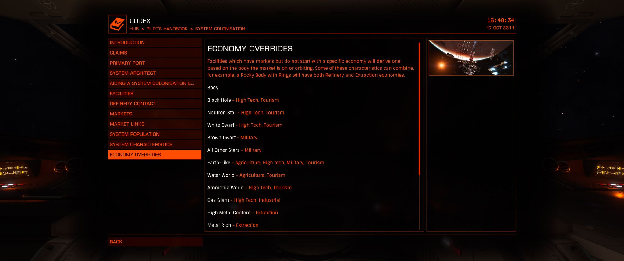
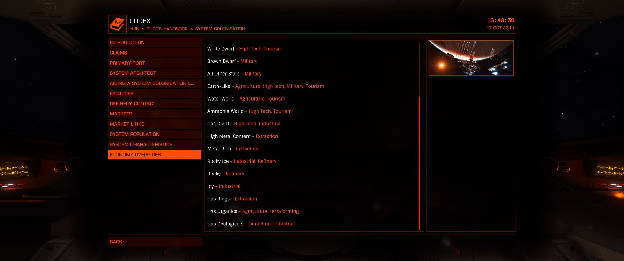


Footnotes
-
3.3 Patch notes on website are incorrect. The correct ones are in the official Frontier Forums post. ↩
-
This is NOT reported in the patch notes, but IS reported in the in-game Codex, and experimental verification proved that the latter source is correct. ↩
-
Primary Ports present an exception to this rule, as they generate their applicable construction points but do NOT require any construction points to be built as the initial Port in a given system. ↩
-
This is a meme and an inside joke about CMDR Mechan’s almost-universally-criticized preference (to the point of him being jokingly labeled the “Krait Mk2 2m2s salesman”) for a widely-considered-undergunned Krait Mk2 ↩
-
The exact formula is: Weekly Earnings = (System Score) * (10,000) * (1 + System Happiness) ↩
-
Note that purchasing an Imperial Cutter requires an Imperial Navy rank of Duke or higher. If you do choose to purchase one, note that the Summerland discount (which applies not only to the initial ship purchase, but lowers ALL future rebuys) is still 30% from a long-past community goal (and not 10% like the wiki says. Inara is also incorrect on this one.) Buy your Imperial Cutter in Summerland! ↩
-
In rare cases, it has been reported that the 2nd faction can also come from outside the originating system. The circumstances upon which it occurs require additional investigation. ↩
-
Needs further confirmation. ↩
-
As described above, keep in mind that the Primary Port DOES NOT COUNT towards this limit. ↩
-
30 nominally, with 2 being supplied by the T2 stations ↩
-
Technically shipyard and outfitting require Tech Level 35, but TL35 is automatically granted upon completion of a Tier 2 or Tier 3 Port, thus guaranteeing these services will always be active at T2+ ports. ↩
-
You may occasionally see economy strengths expressed as percentages. For all intents and purposes, 1.0 = 100% and can be used interchangeably. We prefer the absolute notation as the concept of “100%” is meaningless as it pertains to economy types and strengths, and economy strengths can and do routinely go well above 1 [100%]. ↩
-
Confusingly, Volcanism ALSO provides a bonus to planetary intrinsic values, in addition to strong links. ↩
-
Geologicals (and rings) do not boost extraction on a planet with an intrinsic extraction economy, and geologicals also introduce an industrial market, which can interfere with extraction ↩
-
While geologicals would boost industrial (noting they don’t appear to stack with the Icy Body intrinsic), they also introduce extraction which is undesirable for an industrial economy ↩
-
While an Earth-Like-World also works, the additional economies of an ELW are undesirable for a specialized Agriculture port ↩
-
ELWs are undesirable for specialized hitech markets given their economy mixes; Gas giants can somewhat be made to work, but aren’t a top pick. ↩
-
No Tier 3 facility which autonomously creates strong links exists; however, Tier 3 ports can be made to generate strong links to each other - either by building a planetary Tier 3 port and an Orbital T3 port around the same body, or by building multiple Tier 3 spaceports around the same body. ↩
-
Ports which have converted to supporting facility by being "subordinate" to another local body port are the exception - these are not affected by weak links. See relevant document section for details. ↩
-
If both one (or more) planetary port AND one (or more) space port are present, strong links will form with both the planetary AND space primary ports. ↩
-
Note that binary planets, and moons of planets, count as separate bodies for this purpose ↩
-
“Life” on Water Worlds, Ammonia Worlds, Gas Giants, and Earth-Like Worlds does NOT count as “organics” for this purpose. ↩
-
Source: https://www.elitedangerous.com/update-notes/4-1-2-102 ↩
-
The rare exception would be a primary port around an Earth-Like World or Water World, in a system that is also generally desirable. Those would be candidates for a Tier 3 first-station effort, should you feel you have the stamina for it. ↩
-
If you find something like dual Earth-Like-Worlds orbiting a ringed Neutron [B] star and want to make it the ultimate tourist destination, that might possibly be an exception to this rule. ↩
-
We presume that it is simply alphabetical order for same-strength economies, but we need to do more research to unambiguously confirm it. ↩
-
Note that while these are daily ticks, they are usually split over 15 days (not 14) between 13 “full ticks” and an initial and final “partial ticks” on days C+1 and C+15 (and sometimes even C+16) ↩
-
The formula for ground ports appears similar, but the inflection point is 120 days (vs 100). ↩
-
120 for Planetary Ports, 100 for Space Ports ↩
-
If you don’t log in on a given week, payments accumulate and will all show in a single game-mail which adds them up, once you ultimately do log in. Furthermore, facilities which are built mid-week can contribute a portion of their full credits to the weekly payment. So a station built mid-week would contribute ~10,000 / 2 = ~5k credits per point. ↩
-
This value can vary week by week by +/- 2% roughly ↩
-
Supercruise assist, to a certain degree, can drop you at your target even when travelling above the “blue zone” velocity normally required for a drop. This can be leveraged to significantly speed up supercruise travel. ↩
Guide by CMDR Mechan and contributors. Read or comment on the original Google Doc. Plan your system with tools linked in the guide, and track construction in your colony projects.